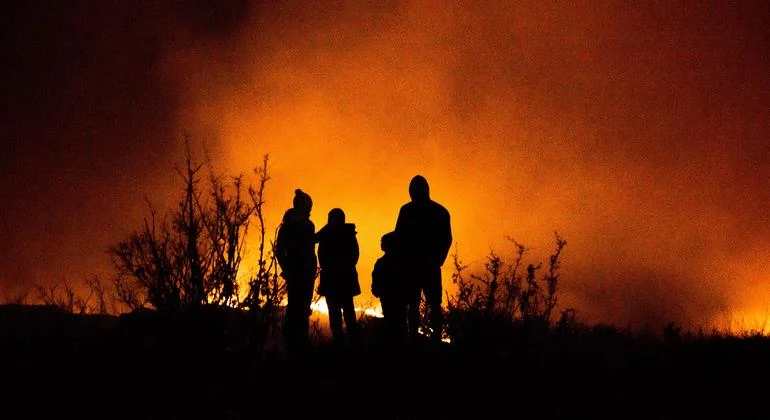
Europe is grappling with an unprecedented wildfire crisis in 2025, with vast swathes of land incinerated and tens of thousands forced to evacuate their homes. The scale of destruction has surpassed previous years, painting a stark picture of escalating climate change impacts across the continent. According to data compiled by the World Health Organization (WHO), wildfires ravaged an staggering 2.2 million hectares of land across the WHO’s European Region in 2025, a dramatic increase from the 1.4 million hectares recorded just three years prior in 2022. This alarming surge underscores a growing environmental and humanitarian challenge that is testing the resilience of emergency services and public health systems alike.
Escalation Across Europe: The 2025 Fire Season
The current wildfire season has been particularly brutal, characterized by its early onset, intensity, and widespread geographical reach. While fires are a recurring summer phenomenon in many parts of Southern Europe, the 2025 season has distinguished itself through its sheer destructive power and the rapidity with which blazes have spread. Countries traditionally vulnerable to wildfires, such as Spain, Portugal, France, Greece, and Italy, have been hit hardest, but even regions further north have experienced uncharacteristic outbreaks, indicative of broader climatic shifts. The 57% increase in burnt land between 2022 and 2025 highlights a worrying trajectory that demands urgent, coordinated action.
Crisis in the Iberian Peninsula
The Iberian Peninsula has emerged as one of the epicentres of this year’s crisis. Spain and Portugal, in particular, have witnessed a more than doubling of wildfire incidents compared to the previous year, stretching their firefighting capabilities to their limits. In Spain, the situation reached a critical juncture when Madrid declared a national emergency on a Friday in mid-summer, as massive wildfires encroached dangerously close to the capital. The fires necessitated the immediate evacuation of approximately 10,000 residents from affected communities, disrupting lives and creating an urgent humanitarian situation. Regional government officials described these particular blazes as the "worst ever" recorded in the vicinity of Madrid, a testament to their ferocity and scale. Beyond the immediate capital region, other autonomous communities such as Andalusia, Catalonia, and Galicia have also reported significant outbreaks, with thousands of hectares of forests and agricultural land turned to ash. The economic impact on rural communities, reliant on agriculture and tourism, is expected to be profound, adding another layer of complexity to the recovery efforts.
France Under Siege
Southern France has similarly endured a devastating fire season. Authorities reported that around 63,000 people were forced to evacuate their homes across multiple departments, particularly in regions like Provence-Alpes-Côte d’Azur and Nouvelle-Aquitaine, which frequently bear the brunt of summer infernos. These rapid evacuations were prompted by fast-moving blazes that had already consumed approximately 80 homes, leaving behind a trail of destruction and displacement. The scale of the evacuations, often carried out under extreme pressure and against a backdrop of thick smoke and unpredictable winds, underscored the immediate threat to human life and property. Firefighting efforts involved substantial national and international resources, including aerial water bombers and thousands of ground personnel, battling relentless flames across diverse terrains.
The Climate Nexus: Fueling the Inferno
The WHO has unequivocally linked the intensifying wildfire crisis to climate change, asserting that it is both increasing their frequency and exacerbating their severity. This connection is not merely theoretical; it is rooted in observable environmental shifts. Rising global temperatures contribute directly to drier conditions, transforming once-resilient landscapes into highly combustible fuel sources. Prolonged periods of drought, coupled with record-breaking heatwaves, create what meteorologists refer to as ‘fire weather’ – conditions ripe for ignition and rapid spread. Furthermore, increasing urbanization, particularly at the wildland-urban interface where human settlements meet natural landscapes, inadvertently extends the length of the wildfire season. This interface provides more ignition points, both accidental and intentional, and increases the vulnerability of communities to encroaching flames. The Mediterranean basin, already prone to summer droughts, is particularly susceptible to these amplified risks, experiencing longer, hotter, and drier periods that extend the traditional fire season well beyond its historical boundaries. The accumulation of biomass due to changes in land management practices, including reduced traditional grazing and forest clearance, also contributes to the fuel load, making fires harder to control once they ignite.
A Devastating Trajectory: Historical Context and Trends
While wildfires have always been a natural part of many European ecosystems, their current scale and intensity represent a significant departure from historical norms. Over the past few decades, scientific consensus has solidified around the idea that human-induced climate change is altering fire regimes globally. In Europe, the 2000s saw several severe fire seasons, but the trend has accelerated dramatically in the 2020s. The average size of fires is increasing, and the capacity of traditional firefighting methods to contain them is being severely tested. The shift from smaller, more manageable fires to large-scale, often uncontrollable "megafires" is a critical concern. These megafires release immense amounts of carbon dioxide, creating a feedback loop that further exacerbates climate change, contributing to a vicious cycle of warming and increased fire risk. Furthermore, the ecological recovery after such intense fires can be slow or even impossible in some areas, leading to permanent landscape changes, soil erosion, and biodiversity loss.
Humanitarian Toll and Health Impacts
Beyond the immediate destruction of homes and livelihoods, the WHO has issued stark warnings about the broader humanitarian and health impacts of wildfires. The forced evacuations place enormous pressure on emergency services, health systems, and local infrastructure, requiring rapid deployment of resources for shelter, food, and medical care. Tragically, wildfires also claim lives, both directly through burns and smoke inhalation, and indirectly through related health complications.
The pervasive smoke plumes, often travelling hundreds or even thousands of kilometres from the source, pose a significant public health threat. Smoke from wildfires is a complex mixture of gases and fine particulate matter (PM2.5), which can penetrate deep into the lungs and enter the bloodstream. The WHO warned that exposure to this smoke can severely worsen existing heart and respiratory conditions, making individuals with chronic diseases, such as asthma, chronic obstructive pulmonary disease (COPD), and heart disease, particularly vulnerable. Older people, young children, and pregnant women are also at heightened risk, facing increased chances of respiratory infections, adverse birth outcomes, and exacerbated chronic conditions.
Studies cited by the WHO indicate that particulate matter from wildfire smoke contributes to a range of serious health issues beyond immediate respiratory distress. These include, but are not limited to, lung diseases, liver diseases, and eye infections. Emerging research also suggests links to cognitive impairment and memory loss, highlighting the long-term neurological consequences of prolonged exposure. The disruption of access to healthcare facilities and other public services during a wildfire event further compounds these health challenges, as routine medical appointments are cancelled, and emergency services become overwhelmed. Moreover, the psychological toll on affected communities is immense, leading to increased rates of anxiety, depression, and post-traumatic stress disorder (PTSD) among those who have lost homes, livelihoods, or loved ones.
Economic and Ecological Fallout
The economic ramifications of the 2025 wildfire season are projected to be staggering. Direct costs include emergency response, firefighting operations, and property damage, which runs into billions of euros across the continent. Indirect costs are even more far-reaching, encompassing losses in agriculture due to burnt crops and livestock, disruption to tourism in affected regions, and damage to vital infrastructure such as power lines, roads, and communication networks. Many rural economies, heavily dependent on these sectors, face years of recovery.
Ecologically, the destruction is catastrophic. Forests, which act as crucial carbon sinks, are incinerated, releasing stored carbon back into the atmosphere and contributing to climate change. Biodiversity is severely impacted, with countless species of flora and fauna losing their habitats or perishing in the flames. Soil degradation, increased erosion, and water contamination are also common consequences, leading to long-term environmental damage and threatening ecosystems that may take centuries to recover, if at all. Protected natural parks and reserves, often rich in unique biodiversity, have been particularly hard hit, representing an irreplaceable loss for Europe’s natural heritage.
Official Responses and Calls to Action
In response to the escalating crisis, national governments across Europe have activated emergency protocols, deploying thousands of firefighters, military personnel, and volunteers. International cooperation, through mechanisms like the EU Civil Protection Mechanism, has facilitated the rapid deployment of resources such as water-bombing aircraft from other member states. The WHO has played a crucial role in providing public health advice, urging people living in or travelling through wildfire-affected areas to follow official guidance from local authorities, evacuate when advised, avoid unnecessary travel, and wear well-fitting protective masks if they must venture outdoors.
Beyond immediate response, the WHO emphasized the critical role of governments in proactive measures: providing timely weather alerts, issuing clear and accessible health advice, and ensuring robust primary and emergency care, with special assistance for the most vulnerable populations. The WHO Europe office reiterated its commitment to working with countries to assess risks, plan for emergencies, develop guidance to protect people from smoke and extreme heat, and enhance the resilience of health services and facilities.
Echoing these calls for proactive measures, Simon Stiell, the UN’s top climate change official and Executive Secretary of the UNFCCC, issued a powerful statement on Friday, linking the escalating climate disasters, including wildfires, directly to the need for an accelerated transition to renewable energy. He stressed that "Action now is the basis of long-term peace and security around the world," highlighting the global implications of climate inaction and the urgency of shifting away from fossil fuels. His remarks underscore a growing international consensus that addressing the root causes of climate change, through rapid decarbonization, is the most effective long-term strategy for mitigating such devastating events.
Challenges in Preparedness and Prevention
Despite advances in firefighting technology and emergency response protocols, the sheer scale and intensity of the 2025 wildfire season have exposed significant challenges in preparedness and prevention across Europe. Many countries face an ageing firefighting fleet, underfunded rural fire services, and a shortage of personnel. There is a growing recognition that prevention strategies need to evolve beyond simply extinguishing fires to include comprehensive land management, forest thinning, controlled burns, and public education campaigns aimed at reducing human-caused ignitions. The fragmentation of responsibilities across different levels of government and varying administrative capacities also sometimes hinders a truly coordinated and effective response. Cross-border cooperation, while present, needs to be further streamlined and resourced to tackle blazes that do not respect national boundaries.
The Path Forward: Resilience and Adaptation
The 2025 wildfire crisis serves as a stark reminder that Europe must adapt rapidly to a changing climate. Building resilience involves a multi-faceted approach: investing in early warning systems, enhancing firefighting capabilities, and crucially, implementing long-term climate mitigation strategies. This includes accelerating the energy transition, as advocated by the UN, but also focusing on nature-based solutions for landscape management, restoring degraded ecosystems, and promoting sustainable agricultural practices that reduce fire risk. Urban planning also needs to consider the wildland-urban interface more carefully, implementing fire-resistant building codes and creating defensible spaces around communities. Education and community engagement are paramount, empowering citizens with knowledge on how to prevent fires and protect themselves during an event. The collective experience of the 2025 fire season must catalyze a more ambitious and integrated approach to climate action and disaster preparedness, ensuring a safer and more resilient future for Europe’s communities and natural heritage.
Related posts: