The Forgotten Pioneer: How Mitsubishi and Hyundai Built the World’s First Direct-Injection Gasoline V8

When automotive enthusiasts reminisce about Mitsubishi’s golden era of motorsport dominance, images of turbocharged four-cylinder rally machines conquering muddy European stages or rugged Mitsubishi Pajeros bounding across the treacherous dunes of the Paris-Dakar rally instantly come to mind. During the 1980s, 1990s, and early 2000s, the Japanese manufacturer built its formidable global reputation on lightweight maneuverability, robust all-wheel-drive systems, and forced-induction agility. A large-displacement V8 engine feels antithetical to this heritage.
Today, visiting a North American Mitsubishi dealership reveals a contemporary lineup dominated by efficient crossovers, compact SUVs, a plug-in hybrid, and the forward-looking promise of pure electric vehicles. A traditional eight-cylinder power plant would look entirely out of place in this family-oriented ecosystem. While it is true that Mitsubishi did develop a massive 20-liter V8 engine back in 1992, that industrial behemoth was exclusively engineered for heavy-duty dump trucks and featured an exhaust-brake system bearing the unfortunate, albeit memorable, official moniker "Powertard."
Yet, despite its lack of association with traditional American muscle or high-displacement luxury cruisers, Mitsubishi holds a monumental and largely overlooked place in automotive engineering history. The Japanese automaker is the rightful corporate pioneer behind the world’s first series-production gasoline direct-injection (GDI) V8 engine. This exceptionally rare piece of mechanical engineering—known officially as the Mitsubishi 8A80—was the sole member of the elusive 8A8 engine family. Developed in a joint venture with South Korea’s Hyundai Motor Company to power their respective flagship luxury flagships, this naturally aspirated 4.5-liter V8 produced an impressive 276 horsepower and 304 pound-feet of torque. At the time of its debut, it was lauded by engineering publications for delivering superior power output alongside enhanced fuel efficiency, a feat achieved by injecting fuel directly into the combustion chambers rather than the intake manifold.
The Genesis of Gasoline Direct Injection in High-Displacement Engines
To understand the significance of the 8A80 engine, one must examine the automotive landscape of the late 1990s. Emissions regulations were tightening globally, and fuel economy was becoming an increasingly critical metric for automakers. While diesel engines had successfully utilized direct-injection technology for years, applying the concept to gasoline-powered engines presented severe technical hurdles, particularly regarding particulate emissions, sulfur tolerance, and precise fuel metering under fluctuating loads.
Mitsubishi was an early adopter and champion of GDI technology, rolling out a diverse family of smaller, four-cylinder GDI engines into its domestic Japanese market vehicles mid-decade. However, scaling this complex technology up to a multi-cylinder, high-displacement V8 configuration required massive financial investments and rigorous research and development. To share the immense costs and engineering burdens, Mitsubishi partnered with Hyundai, an ambitious automaker rapidly expanding its technological capabilities.
Under the terms of their collaborative agreement, responsibilities were cleanly divided. Hyundai predominantly took charge of engineering the robust bottom end of the engine block, ensuring structural integrity and longevity. Meanwhile, Mitsubishi spearheaded the development of the sophisticated high-pressure fuel-injection system, the advanced electronic management controls, and the specialized cylinder heads necessary to optimize air-fuel tumble inside the combustion chambers.
The resulting 8A80 power plant was a technological tour de force. By spraying fuel at ultra-high pressures directly into the cylinders, the engine could operate on a stratified charge lean-burn mode during light-load cruising, drastically reducing fuel consumption. When the driver demanded sudden acceleration, the system seamlessly switched to a stoichiometric air-fuel ratio, unleashing the full 276 horsepower.
A Rare Engine Destined for Obscure Luxury Sedans
Despite being a watershed moment for internal combustion engineering, the world’s first direct-injection V8 was never destined for the mass market, nor did it find a home in the V8-obsessed North American theater. Instead, it was deployed exclusively into ultra-exclusive, low-volume luxury sedans marketed primarily in Japan and South Korea.
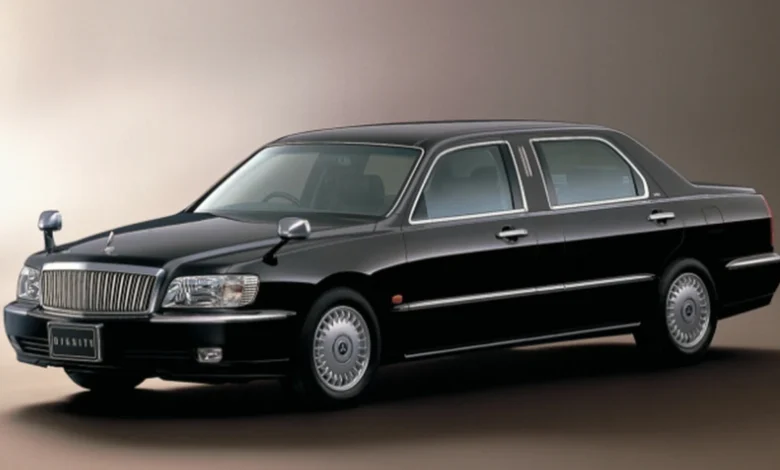
In Japan, Mitsubishi sought to challenge the domestic dominance of the prestigious Toyota Century—a vehicle long favored by government officials, corporate magnates, and royalty. To achieve this, Mitsubishi developed the Proudia sedan and its stretched, ultra-luxurious limousine variant, the Dignity. These imposing vehicles were designed to replace the aging Mitsubishi Debonair, serving as the ultimate expression of corporate prestige for the brand. The Dignity, in particular, was reserved strictly for the highest echelons of society and was powered exclusively by the 4.5-liter GDI 8A80 V8 engine.
Concurrently, across the Sea of Japan, Hyundai utilized the technological fruits of the partnership to launch its own first-generation flagship luxury sedan: the Hyundai Equus (marketed as the Centennial in select export territories). Hyundai offered its version of the GDI V8—internally designated as the G8AA—as the top-tier engine option for the Equus, positioning the vehicle as a direct competitor to established European luxury imports from Mercedes-Benz and BMW.
Market Reception and Commercial Stagnation
Unfortunately, the grand ambitions of Mitsubishi and Hyundai met a harsh commercial reality. In the ultra-conservative executive car market, buyers purchasing status-symbol sedans placed a higher value on brand heritage, plush interior appointments, and traditional prestige than on pioneering under-the-hood combustion technology.
For Mitsubishi, the Proudia and Dignity rollout proved to be a catastrophic commercial failure. The vehicles suffered from high price tags, fierce competition from entrenched domestic rivals like the Toyota Century and Nissan President, and consumer skepticism regarding Mitsubishi’s ability to compete in the ultra-luxury segment. Production numbers reflect the magnitude of the flop: between 1999 and 2001, a mere 1,227 units of the Proudia were manufactured before Mitsubishi pulled the plug. The ultra-exclusive Dignity fared even worse, with a paltry 59 examples leaving the assembly line over the exact same production window.
While the Dignity relied solely on the 8A80 V8, the Proudia was also offered with a smaller GDI-equipped V6 engine. Because Mitsubishi’s historical manufacturing records did not segregate production totals by specific engine choice, exact figures for how many Proudias actually left the factory equipped with the V8 remain shrouded in ambiguity. What is certain, however, is that total production numbers for the V8 variant were vanishingly small, cementing the engine’s status as a unicorn among automotive historians.
Hyundai’s Divergent Path and Comparative Success
While Mitsubishi’s luxury sedan venture collapsed under the weight of poor sales and corporate restructuring, Hyundai’s iteration of the platform achieved considerably more traction, demonstrating the starkly different trajectories of the two manufacturing partners during the turn of the millennium.
The first-generation Hyundai Equus went on to enjoy a remarkably long production run, remaining on sale until 2009. During its decade-long lifecycle, Hyundai manufactured more than 110,000 examples of the Equus. While the majority of these vehicles were equipped with more modest V6 power plants, a significant portion featured the G8AA direct-injection V8.
Hard data regarding the exact number of V8-powered Equus models built remains difficult to extract from corporate archives, but government safety and regulatory filings offer vital clues. A sweeping vehicle recall issued by the South Korean government in 2004 involved 29,932 units of the Hyundai Equus. Within regulatory and manufacturing audit documentation associated with this safety action, records indicated that at least 3,156 of the recalled vehicles were powered by the GDI V8 engine. While this figure highlights that the V8 was far from a volume seller even for Hyundai, it nevertheless confirms that the South Korean automaker produced significantly more units of the engine than its Japanese partner.
Chronology of a Technological Milestone
To fully appreciate the historical arc of the Mitsubishi-Hyundai GDI V8 project, a chronological overview outlines its development, peak, and subsequent obsolescence:
- Early 1990s: Mitsubishi begins intensive research and development into gasoline direct-injection (GDI) technology, recognizing its potential to drastically improve thermal efficiency and reduce carbon emissions.
- Mid-1990s: Mitsubishi successfully launches smaller, four-cylinder GDI engines into the Japanese domestic market, proving the viability of the technology on a commercial scale.
- Late 1990s: Recognizing the immense capital required to scale GDI technology to a high-displacement eight-cylinder configuration, Mitsubishi enters a formal joint development partnership with Hyundai Motor Company.
- 1999: The fruits of the collaboration debut. Mitsubishi introduces the Proudia sedan and Dignity limousine in Japan, powered by the 4.5-liter 8A80 GDI V8. Simultaneously, Hyundai introduces the Equus (Centennial) in South Korea, featuring its variant of the engine, the G8AA.
- 1999–2001: Commercial failure plagues Mitsubishi’s luxury division. Production of the Proudia and Dignity is abruptly halted after just 1,227 Proudias and 59 Dignities are built, making the 8A80 engine exceptionally rare.
- 2004: A major South Korean government recall concerning 29,932 units of the Hyundai Equus documents at least 3,156 V8-powered variants, underscoring the relative rarity of the engine even within Hyundai’s more successful lineup.
- 2009: Hyundai officially phases out the first-generation Equus, bringing a final conclusion to the operational era of the foundational GDI V8 architecture.
Broader Industry Implications and Legacy
Though the Mitsubishi 8A80 and Hyundai G8AA engines are largely forgotten footnotes in the grand narrative of the global automotive industry, their introduction marked a pivotal technical stepping stone.
By proving that gasoline direct-injection could be successfully scaled up to large, multi-cylinder configurations and deployed in series production, Mitsubishi and Hyundai broke technological ground that the rest of the world would soon follow. Within a decade of the 8A80’s debut, tightening global emissions standards—most notably Euro 5 and Euro 6 regulations—forced virtually every major global automaker to abandon traditional port fuel injection in favor of direct-injection systems across all engine architectures, from inline-fours to massive twin-turbocharged V8s found in high-performance sports cars and luxury SUVs.
Today, direct injection is an omnipresent, standard technology in modern internal combustion engines. Yet, the credit for putting the world’s first gasoline direct-injection V8 onto public roads does not belong to the traditional automotive powerhouses of Detroit or Stuttgart. Instead, it belongs to an unexpected collaboration between a Japanese rally icon transitioning through financial turbulence and an ambitious South Korean manufacturer on the cusp of global expansion. For automotive historians and rare-car hunters, tracking down a surviving Mitsubishi Dignity or an early GDI-powered Hyundai Equus offers a rare glimpse into a bold, albeit commercially star-crossed, engineering experiment that permanently altered the DNA of the modern internal combustion engine.