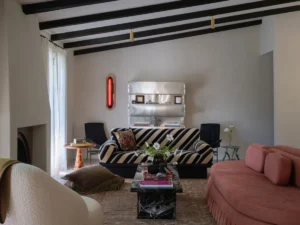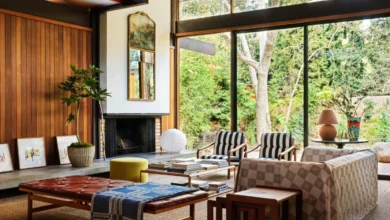
The transformation of Lucy Hale’s Los Angeles residence from a conventional farmhouse-inspired space into a deeply personal, "moody femme" sanctuary serves as a poignant reflection of the actor’s personal evolution. Hale, 37, who gained global recognition for her starring role in the long-running teen drama Pretty Little Liars, acquired the 1940s Spanish-style property in 2019. Over the subsequent five years, the home has undergone a series of meticulous renovations that parallel the actor’s own journey toward sobriety, self-discovery, and the embrace of a more authentic, singular aesthetic.
.jpg)
A Chronology of Personal and Architectural Growth
When Hale first purchased the canyon-tucked property in 2019, her approach to interior design was dictated by a desire for neutrality and calm. Having spent the better part of her twenties in the high-pressure environment of network television, she opted for a safe, "farmhouse-y" aesthetic that prioritized light and simplicity. However, as Hale entered her thirties, her relationship with her environment began to shift.
.jpg)
The year 2022 marked a critical turning point. Following her decision to pursue sobriety and a more intentional focus on mental health, Hale realized that her home no longer mirrored the woman she was becoming. The space felt detached from her internal reality. To rectify this, she engaged the services of Ashley Drost and Marie Trohman, the principals of the Los Angeles-based design firm Proem. Known for their ability to blend eclecticism with structural integrity—notably demonstrated in their work for fellow actor Emma Chamberlain—Drost and Trohman were tasked with helping Hale translate her internal maturation into a physical space.

The Philosophy of Moody Femme Design
The collaborative design process, which spanned three years, sought to introduce what Drost and Trohman coined as "moody femme" decor. This sensibility is characterized by a departure from the stark whites and beiges of Hale’s earlier iteration of the home, moving toward a palette rich in plums, aubergines, and saturated pinks.

Drost describes the color scheme as reminiscent of an "eye shadow palette," a choice that provides a cohesive yet dramatic backdrop. The renovation included structural adjustments, such as the addition of wood ceiling beams to reclaim the home’s original Spanish-style architectural roots, and the installation of custom elements that reflect Hale’s specific interests. For instance, the entry foyer now features an archway with hand-painted Tabarka tiles, while the primary bathroom is lined in Portola Roman Clay, providing a tactile, grounded atmosphere.

Curating a Sanctuary of Memory
The interior design is not merely an exercise in aesthetics but a deliberate curation of personal history and sentiment. Hale has incorporated elements that honor her Memphis, Tennessee, roots, such as a vintage Elvis Presley lamp that sits in the media room bar. Her fascination with the "good witchy" aesthetic is reflected in the home’s more idiosyncratic pieces, such as the life-size sheep sculpture—named George—and a breakfast nook featuring a painting of a figure riding a horse while being fed snacks.

The most significant aspect of the home’s redesign, however, is its role as a memorial. The meditation room and hallways serve as sacred spaces where Hale displays photographs of her late grandmother, great-grandparents, and her father, Preston Hale, who passed away in July of this year. By creating a dedicated space—such as the white "Dad’s chair" in the living room—Hale has successfully integrated her grief and her family history into her daily environment. This intentionality, she notes, is a vital part of her ongoing healing process.

Strategic Design and Materiality
The project utilized a mix of high-end custom fabrication and vintage sourcing. Proem’s work involved balancing textures and eras, pairing 1950s Italian furniture with contemporary art. Notable features include:

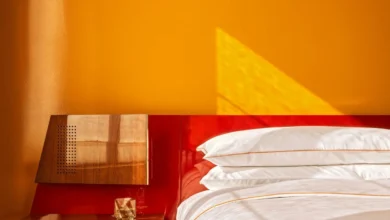
- The Bedroom: A nubuck leather bed by Baxter, positioned low to the floor to accommodate her Maltipoos, Elvis and Ethel, sits against walls covered in custom linen wallpaper by French firm Élitis, creating the intimacy of a Parisian jewel box.
- The Media Room: A vintage modular sofa by Pamio, Toso, and Massari for Stilwood, upholstered in Dedar velvet, provides a communal space that remains deeply personal.
- The Kitchen: The cabinetry color, inspired by a kitchen designed by Jane Hallworth for Kirsten Dunst, utilizes deep, moody tones to provide a sense of architectural gravitas.
These choices reflect an understanding of material density. The use of Roman Clay, wool rugs from Woven, and custom leather banquettes ensures that every surface provides a sensory experience, moving away from the ephemeral, "neutral" design trends that defined the late 2010s.

Implications of the "Home-as-Healer" Trend
Hale’s home serves as a case study in a broader trend within the luxury design sector: the shift toward spaces that facilitate psychological well-being. For public figures who have spent their careers in the spotlight, the home has increasingly become a fortress against external pressures. Hale’s decision to own the house outright and renovate it without external compromise is a testament to her assertion of agency.

"I want every corner of this house to make me excited," Hale states. This statement highlights the growing demand for interior design that serves as an extension of the self, rather than a display of social status. By treating her home as a living entity—one that evolves with her—Hale is participating in a dialogue about the importance of domestic spaces in the maintenance of long-term mental health.

Official Perspectives and Future Outlook
The designers, Drost and Trohman, have noted that the project was unique in its emotional intensity. During their interviews, the pair remarked on the strength of character they perceived in Hale from their earliest meetings. Their ability to synthesize her "witchy" sensibilities into a coherent, regal design resulted in a space that feels both romantic and edgy.

As Hale moves forward in her career and personal life, the home stands as a milestone. She acknowledges that while she may not live in the property forever, she intends to retain ownership of it indefinitely, viewing it as a foundation for her future. For an actor who spent her formative years navigating the scrutiny of a hit television show, the ability to curate a space that is entirely her own represents a significant achievement.

The home, with its mix of whimsical art, ancestral mementos, and high-design furnishings, offers a glimpse into a life that is no longer being lived for the cameras. It is a quiet, deliberate, and deeply feminine expression of resilience, proving that the most successful interior design projects are those that do not simply decorate a space, but rather hold the inhabitant through their most challenging transitions. Whether through the sunlight reflecting off an aluminum sculpture or the presence of a "Dad’s chair," the residence effectively bridges the gap between the past and the present, providing a stable, loving container for the future.