New Sanctuary Established to Protect the Endangered Indus River Dolphin Amidst Ongoing Environmental Challenges

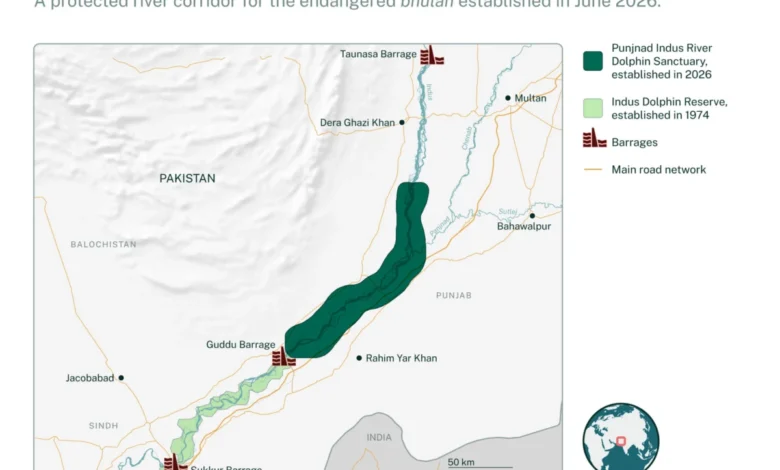
The Indus River, a lifeline for millions across Pakistan, serves as the singular home for one of the world’s most unique cetaceans: the Indus River dolphin (Platanista minor). Locally referred to as the bhulan, this freshwater mammal has survived for millions of years in the murky, silt-heavy waters of the Indus Basin. In a significant conservation milestone, the government of Pakistan officially inaugurated the Punjnad Indus River Dolphin Sanctuary in June 2026. This newly protected zone encompasses nearly 200 kilometers (123 miles) of riverine habitat in Punjab, effectively linking with existing protected areas in the Sindh province to create a contiguous 400-kilometer (249-mile) corridor of legal sanctuary for a species that was once on the brink of extinction.

A Deep Evolutionary History
The lineage of the Indus River dolphin stretches back between 11 million and 16 million years, tracing its origins to the middle Miocene period. During this era of high sea levels, the ancestors of the bhulan migrated into the ancient Indus Basin. As the basin transformed, so did the dolphins; they underwent a profound evolutionary metamorphosis. To survive in the perpetually muddy, low-visibility environment of the river, they developed a highly advanced biological sonar—echolocation—which serves as their primary sensory tool. Conversely, the species gradually lost its visual acuity, rendering it functionally blind in the traditional sense. Today, these mammals navigate the shallows by swimming on their sides, a unique adaptation that allows them to maneuver through the river’s complex topography.
Population Fluctuations and the Brink of Extinction
The history of the Indus River dolphin is marked by a dramatic decline followed by a cautious, science-led recovery. In the late 19th century, historical estimates suggested a population of approximately 10,000 individuals inhabiting the river system from the foothills of the Himalayas to the Indus Delta. However, the 20th century brought rapid industrialization, large-scale water diversion, and intensive agriculture. By 2001, the population had plummeted to a precarious 617 individuals.

The subsequent two decades saw a concerted effort by environmentalists, government agencies, and international organizations to reverse this trend. Legal protections, including a total ban on hunting in the 1970s, laid the groundwork for recovery. A landmark 2025 study published in the journal Endangered Species Research provided the most comprehensive census to date, revealing a population of 1,987 individuals. This 19.4% increase recorded between 2011 and 2017 serves as a testament to the efficacy of targeted conservation interventions. Today, nearly 99% of the surviving population is concentrated in a 690-kilometer stretch between the Chashma and Sukkur barrages, highlighting the critical importance of these specific river segments.
The Infrastructure Crisis: Barrages and Fragmentation
Despite the positive population data, the bhulan remains classified as endangered on the IUCN Red List. Their primary challenge is not a lack of interest in their survival, but the physical degradation of their habitat. The Indus River is heavily regulated by a series of massive human-made barrages and irrigation canals. These structures serve as formidable barriers, fragmenting the river into isolated segments that prevent genetic exchange between subpopulations and frequently trap dolphins in irrigation channels where they face life-threatening conditions.

For over twenty years, the World Wildlife Fund (WWF) has operated specialized rescue units, tasked with the arduous, high-stress process of extracting stranded dolphins from shallow canals and transporting them back to the main river channel. While these rescues are vital, they address only the symptoms of a deeper systemic issue: the lack of ecological connectivity. The new Punjnad sanctuary is a crucial step in formalizing protection, yet scientists warn that "legal continuity" does not equate to "ecological connectivity." The barrages remain operational, and the physical barriers they present continue to limit the dolphins’ ability to move freely throughout their ancestral range.
Legislative Milestones and the Role of Governance
The creation of the Punjnad sanctuary represents a shift toward a more holistic, provincial-coordination approach. Javed Mahar, a conservator with the Sindh Wildlife Department, emphasizes that the sanctuary in Punjab is a logical extension of the legislative framework pioneered in Sindh. By aligning the protection standards of Punjab with those of Sindh, the government is creating a unified safety net for the dolphins.

Hamera Aisha, the lead author of the 2025 Endangered Species Research study, notes that the sanctuary provides the necessary legal teeth to regulate commercial fishing—a major source of mortality. Between 2008 and 2023, entanglement in gillnets was identified as the cause of 52% of all documented dolphin deaths. Because commercial fishing contracts in Punjab have historically prioritized volume over sustainability, the establishment of the sanctuary allows for stricter enforcement of gear restrictions and monitoring of fishing activities, providing a more stable environment for the dolphins to forage and reproduce.
Environmental Pressures: Beyond the Nets
While fishing and infrastructure are the most immediate threats, the broader ecosystem is facing mounting pressure from industrial and climate-related factors. Gold mining along the riverbanks, which often utilizes toxic chemicals like mercury and cyanide, poses a grave risk to the water quality and the health of the entire food chain, from small fish to the apex predator: the dolphin.

Furthermore, the escalating climate crisis is altering the hydrological regime of the Indus. Accelerated melting of Himalayan glaciers, combined with unpredictable monsoon patterns, threatens to disrupt the natural flow of the river. The bhulan depends on deep, consistent pools and specific water depths; alterations in these conditions due to water abstraction and changing climate cycles could lead to a decline in habitat quality even in protected zones. As Aisha points out, "Water abstraction and altered flow regimes are directly relevant to dolphin conservation. Pollution from agricultural, municipal, and industrial sources requires greater attention."
Integrating Local Communities in Conservation
A central tenet of the modern conservation strategy for the Indus River dolphin is the inclusion of local fisher communities. Historically, these communities relied on the river for their livelihoods. However, as sustenance fishing has been supplanted by industrial-scale commercial contracts, the relationship between local people and the river has shifted.

The strategy moving forward, as supported by the World Wildlife Fund and provincial authorities, is to incentivize community-based sustainable fishing. By transforming local fishers into stakeholders in the sanctuary’s success, conservationists hope to replace punitive measures with sustainable livelihoods. This approach aligns with the Conservation Assured | River Dolphin Standards (CA|RDS), a global framework designed to manage river systems in a way that balances biodiversity needs with human economic activity.
Future Outlook: A Shared Responsibility
The inauguration of the Punjnad Indus River Dolphin Sanctuary is a landmark event, but it is not the final chapter for the species. The path forward requires a transition from reactive rescue operations to proactive, science-based management. This includes incorporating ecological considerations into the operation of barrages, strictly enforcing anti-pollution measures, and maintaining the flow regimes necessary for the dolphins to thrive.

The Indus River dolphin is an indicator species; its health reflects the overall health of the entire Indus Basin. By protecting the "Queen of the Indus," Pakistan is effectively safeguarding the water security and ecological integrity of the entire region. The recovery of the population to nearly 2,000 individuals provides a glimmer of hope, but the fragility of this existence remains clear. As Dr. Uzma Khan, a co-author of the recent study, aptly stated, the legal designation is a welcome development, but the ultimate responsibility for the species’ future lies in the hands of the human populations that share the river.
The survival of the bhulan will depend on the ability of the government, local communities, and the scientific community to maintain a delicate balance in one of the world’s most heavily utilized and vital river systems. The progress made in 2026 serves as both a celebration of what can be achieved through cooperation and a sober reminder of the persistent, multifaceted threats that still loom over the Indus.