Prepping Your Body for Mogul Season: A Comprehensive Guide to Athletic Training for Elite Skiing Performance

The mastery of mogul skiing remains one of the most demanding physical pursuits in winter sports, requiring a specialized synthesis of agility, strength, and sensory perception. While the fluid, rhythmic motion of a professional skier navigating a bumpy course appears effortless to the spectator, it is the result of years of conditioning and high-level biomechanical coordination. Maddi Beck, a strength and conditioning coach for the U.S. Ski & Snowboard Team, emphasizes that the sport is a highly technical discipline that necessitates intense precision, which can only be fully refined through consistent time on the slopes. However, the physical architecture required to support that technical skill is built primarily in the gym, long before the first snow falls.
The Biomechanics of Mogul Skiing
To understand the training regimen required for mogul skiing, one must first analyze the physical forces at play. Mogul skiing involves rapid, high-frequency impacts as a skier descends a steep pitch characterized by artificial or natural mounds of snow. This environment demands three critical athletic pillars: trunk control, lower-body muscular endurance, and the ability to absorb and redirect significant force.
Trunk control is perhaps the most essential, yet often overlooked, component. In technical skiing, the torso must function as a stabilized platform while the legs move independently and violently beneath it. This separation—often referred to as “upper-lower body dissociation”—allows the skier to maintain a stable center of mass even when the lower body is being jolted by uneven terrain. Failure to maintain this stability places significant strain on the lumbar spine, which is a common site of injury for recreational and competitive skiers alike.
The Role of Conditioning in Injury Mitigation
The U.S. Ski & Snowboard Team places a significant premium on cardiovascular and muscular conditioning, recognizing it as a primary tool for injury prevention. As a competition run progresses, muscle fatigue begins to compromise form. When the quadriceps—the primary shock absorbers in a mogul line—reach a state of exhaustion, the mechanical load shifts to the joints, particularly the knees and lower back.
According to data tracked by sports medicine professionals, a significant percentage of skiing-related injuries occur late in the day or at the end of a long training session when fatigue-induced technique degradation is at its peak. By increasing the threshold for muscular failure through targeted circuits, athletes can maintain “clean” skiing mechanics for longer durations. This is why Beck and her colleagues prioritize high-repetition, low-rest interval training that mimics the sustained physical demand of a professional-grade mogul course.
Core Training: The Foundation of Stability
Building a resilient core requires more than traditional sit-ups. For high-performance skiing, the core must be trained for stability and anti-rotation. The “dead bug” exercise, a staple in Olympic-level programming, is designed to challenge the deep stabilizers of the abdomen while the limbs are in motion. By keeping the lower back pressed firmly against the floor, the athlete learns to control the pelvis and spine under load.
Complementing this is the Pallof press, which targets the obliques and transverse abdominis. By resisting a lateral force—typically from a cable machine or resistance band—the athlete trains the torso to remain rigid. This specific type of strength is critical when a skier hits an unexpected mogul or an icy patch, as it prevents the upper body from being thrown off balance, allowing the skier to recover their line instantaneously.
The Evolution of Leg Power and Endurance
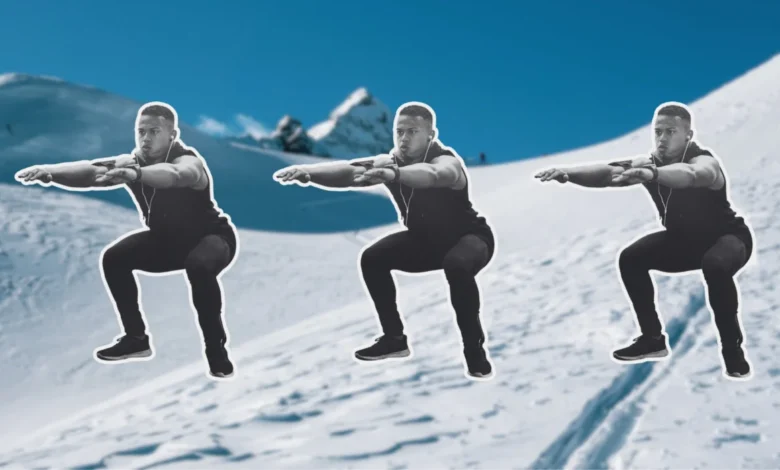
The lower body must function as both a spring and a shock absorber. To develop this, coaches utilize a structured circuit that builds anaerobic capacity. A standard circuit might include bodyweight squats, squat pumps (pulsing at the bottom of the movement), and static squat holds. The objective is to keep the muscles under constant tension for the duration of the set.
As the season approaches, athletes transition from foundational strength to power-based training. Power, in the context of mogul skiing, is the ability to generate force quickly. This is where box jumps and depth jumps become vital. A box jump requires the explosive recruitment of fast-twitch muscle fibers, while a depth jump—stepping off a box and immediately jumping upward upon landing—trains the body’s reactive strength. The transition from the landing phase to the jump phase is known as the “amortization phase.” Minimizing the duration of this phase is what separates elite skiers from amateurs; it is the physical manifestation of the ability to “absorb and redirect” force.
Timeline for Pre-Season Preparation
Athletes typically begin their high-intensity dryland training cycles 12 to 16 weeks before the start of the competitive winter season. The timeline generally follows a three-phase structure:
- Phase One (Weeks 1–4): Structural Integrity. Focus on mobility, core stability, and foundational strength. This phase ensures that the ankles, hips, and spine are prepared for the high-impact loads of later phases.
- Phase Two (Weeks 5–8): Muscular Endurance. The introduction of the aforementioned circuits to increase the time-to-fatigue for the quadriceps and gluteal muscles.
- Phase Three (Weeks 9–12+): Power and Explosiveness. High-impact plyometric training, such as box and depth jumps, is added to the regimen, ensuring the athlete can handle the force of mogul impacts without joint degradation.
Mobility: The Unsung Hero of Performance
While strength is frequently discussed, mobility is the silent guardian of the athlete’s longevity. The ankles and hips are the primary pivot points in skiing. If an athlete lacks dorsiflexion in the ankle, they cannot maintain a proper forward lean in their boots, which leads to “back-seating”—a common form error that makes steering difficult and significantly increases the risk of ACL injuries.
Coaches now integrate mobility drills into the start of every workout. By utilizing dynamic stretching, foam rolling, and joint-articulation exercises, athletes ensure that they have the full range of motion necessary to execute the sharp, aggressive turns required on a mogul field. This is not merely about flexibility; it is about functional range of motion that can be accessed under high-stress, high-speed conditions.
Implications for the Amateur Skier
The strategies employed by the U.S. Ski & Snowboard Team offer a roadmap for any skier looking to improve their performance. While the average skier does not need to train at the same volume as an Olympian, the principles of trunk control, quad endurance, and force absorption are universal.
By dedicating just two days a week to a structured routine—incorporating core stability work, a leg-focused endurance circuit, and controlled plyometric jumps—recreational skiers can significantly reduce their risk of injury and extend their endurance on the mountain. As the winter season approaches, the focus should remain on gradual progression. For those engaging in high-impact plyometric work, the advice from professionals is clear: start with soft landings, prioritize form over height, and ensure the musculoskeletal system is sufficiently warmed up.
Ultimately, the transition from the gym to the mountain is seamless when the body has been conditioned to handle the specific demands of the terrain. Mogul skiing is a test of will and physics, and the most successful athletes are those who treat the off-season not as a period of rest, but as a critical window to build the strength that will carry them through the bumps with efficiency, grace, and safety.
Related posts: