The Make America Healthy Again Movement’s Disenchantment with Trump Over Chemical-Laden Food System and Glyphosate Stance Poses Political Challenges

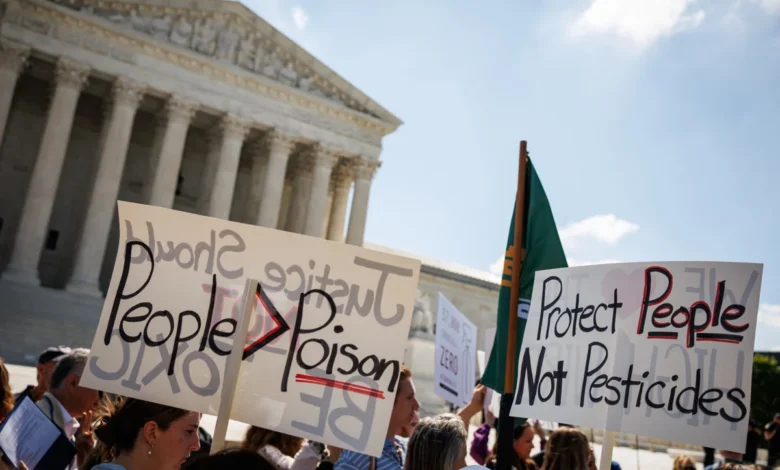
The coalition of voters who helped elect Trump are growing increasingly disenchanted with the president, particularly over his administration’s perceived inconsistencies and reversals on promises to reform the nation’s food system and reduce chemical exposure. This disillusionment, primarily from the "Make America Healthy Again" (MAHA) movement, signals a potential fracturing within a key segment of his base, with significant implications for upcoming elections and the broader political landscape surrounding public health and agriculture.
The Rise of the MAHA Movement: A Call for Health and Purity
The Make America Healthy Again (MAHA) movement emerged as a powerful, albeit often loosely defined, coalition united by a deep concern for public health, food purity, and environmental well-being. Its adherents, often straddling traditional political divides, advocate for a significant reduction in exposure to harmful chemicals, particularly in food and vaccines. While many MAHA supporters voted for Donald Trump in the last election, often swayed by figures like Robert F. Kennedy Jr., who aligned with Trump on promises of cleaning up America’s chemical-laden food system, their faith has begun to fray.
Mollie Engelhart, a prominent figure in the MAHA-aligned community, embodies this evolving sentiment. From her 200-acre organic farm and cattle ranch in Bandera, Texas, Engelhart champions regenerative agriculture, raw milk production, and a daily column advocating for healthier food systems. She recently hosted a two-day MAHA farming retreat, attracting hundreds of politicians, activists, and leaders, including Robert F. Kennedy Jr. Despite her past support, Engelhart expresses profound disappointment. "I think that one hundred percent the MAHA movement is very disappointed and disenchanted, and I am not the only one," she stated, adding, "MAHA voters are homeless." Her primary objection to the MAHA label itself is its potential for "blue team or red team" politicization, emphasizing that the issues transcend partisan lines.
Glyphosate at the Center: A Deep Dive into the Roundup Controversy
Central to MAHA’s disenchantment is the Trump administration’s open support for Bayer, the multinational pharmaceutical and life sciences company, and its flagship product, Roundup, a widely used glyphosate-based herbicide. Glyphosate, the active ingredient in Roundup, has been a subject of intense scientific and legal debate for decades. Introduced by Monsanto (later acquired by Bayer) in the 1970s, it rapidly became the world’s most popular herbicide due to its effectiveness and broad-spectrum weed control.
However, concerns about its potential health impacts began to mount, particularly after the International Agency for Research on Cancer (IARC), a branch of the World Health Organization (WHO), classified glyphosate as "probably carcinogenic to humans" in 2015. This classification, while contested by regulatory bodies like the U.S. Environmental Protection Agency (EPA) and the European Food Safety Authority (EFSA), ignited a firestorm of lawsuits. Tens of thousands of plaintiffs, primarily agricultural workers and gardeners, alleged that exposure to Roundup caused non-Hodgkin lymphoma and other health issues, further claiming that Bayer failed to adequately warn users about these risks on its product labels.
These lawsuits have resulted in multi-million and even multi-billion dollar judgments against Bayer, though many have been reduced on appeal. The legal battles highlight a fundamental tension between regulatory assurances and public health concerns, often exacerbated by scientific studies yielding conflicting results and intense lobbying efforts by chemical manufacturers. The MAHA movement, with its focus on reducing toxic exposures, naturally views glyphosate as a primary antagonist and its continued widespread use as a direct threat to public health.
A Chronology of Contradictions: Trump’s Actions on Glyphosate and Agriculture
The Trump administration’s actions regarding glyphosate and regenerative agriculture unfolded in a sequence that MAHA supporters found deeply contradictory:
- Administration’s Intervention in Supreme Court Case: The administration actively urged the Supreme Court to take up a key case, Monsanto Co. v. Hardeman, which centered on whether federal herbicide labeling laws preempt state-level requirements for cancer warnings. This move was widely seen as siding with Bayer against plaintiffs seeking stronger consumer protections.
- February: Executive Order on Chemical Production: The president signed an executive order classifying glyphosate-based herbicides, among other chemicals, as "key to national security." This order called for increased domestic production of the chemical, framing it as essential for American agriculture and economic competitiveness. This directly contradicted the MAHA ethos of reducing chemical dependence.
- March: EPA Officials Meet with Bayer CEO: Reports surfaced that top officials at the Environmental Protection Agency met with Bayer’s CEO to discuss "litigation issues." This meeting further fueled suspicions among MAHA advocates that the administration was actively collaborating with the chemical giant to undermine legal challenges.
- April: Administration Argues on Behalf of Bayer: The administration dispatched a lawyer to argue on behalf of the chemical company in a Supreme Court hearing. This direct intervention in a case concerning a product linked to cancer allegations solidified the perception that the administration was prioritizing corporate interests over public health.
- June: Supreme Court Ruling and Regenerative Agriculture Executive Order: The Supreme Court delivered a ruling that effectively limited states’ ability to mandate more comprehensive warning labels on products like Roundup than those required by federal law. This decision severely curtailed pathways for legal recourse for future plaintiffs. Hours after this ruling, Trump signed a seemingly contradictory executive order framed as "boosting regenerative agriculture and American farm resilience."
This dual action sparked a fresh barrage of criticisms. Mollie Engelhart articulated the sentiment, describing the situation as "a little schizophrenic." She added, "None of us can be a one-issue voter anymore… I don’t think that anybody is just going to blindly go and vote for one party or another."
Regenerative Agriculture: A Promise or Greenwashing?
The executive order on regenerative agriculture, while seemingly a step towards MAHA ideals, was met with skepticism. Broadly, regenerative agriculture encompasses farming practices that aim to improve soil health, increase biodiversity, enhance water cycles, and sequester carbon. Principles include no-till farming, cover cropping, diverse crop rotations, and integrating livestock. Proponents argue it offers a sustainable path forward, benefiting both the environment and long-term farm viability.
However, critics, including many MAHA supporters, viewed the executive order with suspicion. Mike Lavender, policy director at the National Sustainable Agriculture Coalition, noted, "It may sound great, but fundamentally, there’s nothing really new or substantive or meaningful in the EO that I can see that actually changes the equation for how the administration treats regenerative agriculture." The lack of new funding or binding regulations, coupled with the absence of a federal standard or definition for "regenerative agriculture," leaves it vulnerable to "greenwashing"—where companies or governments make unsubstantiated claims about environmental benefits.
Jonathan Lundgren, a South Dakota farmer practicing regenerative agriculture, was present at the White House for the signing of the executive order. He raises bees, sheep, and poultry on his 50-acre farm and aligns with the anti-pesticide faction of MAHA. While he called the executive order "meaningful" in principle, he acknowledged its limitations. He recounted a heated argument that erupted in the Oval Office between a Department of Health and Human Services official and a top farming lobbyist, the latter concerned that the order might imply safety issues in the U.S. food supply. This incident underscored the internal conflicts and the powerful influence of conventional agriculture lobbies within the administration.
Lundgren’s own experiences highlight the urgency of the issue. He stopped using Roundup eight years ago due to its negative effects on his farm, but still battles herbicide drift from neighboring operations. He observes bees dying and his orchard leaves cupping, direct consequences of chemical exposure. More alarmingly, he reports a human toll: "We’re sick this time of year, and it’s a direct result of all of these pesticides being applied. My family is sick. That ain’t right." His daughter suffers from asthma and allergy flare-ups, while his staff experiences recurring headaches and fatigue, a phenomenon he calls "The Spray Flu" in his community.
Broader Implications: Political Repercussions and Shifting Loyalties
The disenchantment within the MAHA movement is not merely anecdotal; it is beginning to manifest in polling data and shifting political loyalties. Last October, polling revealed that approximately 74 percent of MAHA supporters identified as Republicans, with 59 percent also aligning with the "Make America Great Again" (MAGA) base, Trump’s most loyal constituency. However, a POLITICO poll conducted this spring showed a significant crack in this loyalty: 47 percent of self-identified MAHA respondents who voted for Trump believed the administration had not done enough to "Make America Healthy Again."
Furthermore, a Kaiser Family Foundation poll found that 28 percent of MAHA voters somewhat or strongly disapprove of the administration’s handling of food and vaccine policy. This disapproval could directly impact voter turnout in critical midterm elections, potentially altering control of Congress. A core tenet of the movement, limiting pesticide use, remains overwhelmingly popular, with 94 percent of MAHA adherents favoring reduced exposure to harmful chemicals. This strong consensus on a key issue, contrasted with the administration’s actions, creates a substantial political vulnerability.
Kelly Ryerson, a leading MAHA mom and co-founder of the farming organization American Regeneration, echoed the sentiment of inconsistency. "It’s inconsistent, to say the least," she commented, adding, "If Trump is going to be doing things like the Supreme Court situation, it’s certainly not what anyone voted for… it’ll be really hard to come back from this now." As a registered independent who voted for Trump, Ryerson’s approach to the midterms has shifted fundamentally: "I don’t care if they’re a Republican or Democrat, I’m going to support the candidate that wants to decrease toxic exposures." This indicates a potential move towards issue-based voting, transcending traditional party lines, a trend that could have unpredictable consequences for both major parties.
The Future of Food Policy and Public Health in American Politics
The MAHA movement’s growing disillusionment underscores a significant shift in American politics, where food safety, public health, and environmental concerns are increasingly becoming central electoral issues. Jonathan Lundgren observed, "We’re in a weird state right now that has never really happened before, where food safety and the health of our children is weighing very heavily on American politics. This is far broader than the farming community. I think that this is consumers; I think this is parents; I think this is society at-large."
This sentiment suggests that political candidates, regardless of party affiliation, will face increasing pressure to address concerns about the food system, chemical regulations, and public health. The administration’s perceived pivot from promises of a "cleaner" food system to supporting chemical manufacturers, including the EPA’s recent approval of pesticides containing "forever chemicals" (PFAS), has not only alienated a key segment of its base but also highlighted the powerful influence of agricultural lobbies.
For the Trump campaign and the Republican Party, the challenge lies in reconciling their base’s health concerns with the interests of powerful agricultural industries. For Democrats, there may be an opportunity to court disaffected MAHA voters by offering concrete policies for food system reform and chemical reduction. However, this demographic is complex and often wary of government intervention, requiring nuanced engagement. The political fallout from the glyphosate controversy and the perceived mixed messages on regenerative agriculture suggests that the battle for the hearts and minds of health-conscious voters is far from over, and its outcome could significantly reshape American political alignments for years to come.