A 6-Speed Gated Manual In A 2,031-HP Hypercar Is Either Brilliant Engineering Or A Very Expensive Dare

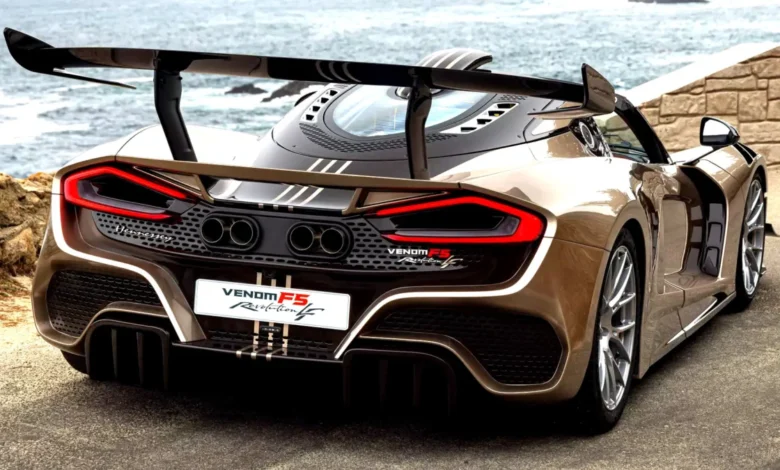
The Venom F5 Revolution LF is not merely a production car with a gearbox swap; it is the flagship product of Hennessey’s "Maverick" bespoke division. This division was established to cater to the most discerning collectors who demand one-of-one specifications that push the boundaries of what is possible within the F5 platform. While the standard Venom F5 utilizes a seven-speed single-clutch automated manual transmission, the Revolution LF introduces a level of driver involvement rarely seen in the hypercar segment, especially at power levels exceeding 2,000 horsepower.
Engineering the 2,031 Horsepower "Fury" V8
At the heart of the Venom F5 Revolution LF lies the "Fury" engine, a 6.6-liter twin-turbocharged V8 that has been recalibrated for this specific application. While the standard Venom F5 is rated at 1,817 horsepower, the LF variant pushes the output to a monumental 2,031 hp. This increase is achieved through optimized turbocharger mapping and enhanced thermal management systems designed to handle the immense heat generated during high-speed runs.
The engine utilizes a combination of high-tech materials and traditional American V8 architecture. It features a cross-plane crankshaft, lightweight forged aluminum pistons, and high-strength connecting rods. The twin turbochargers are precision-engineered to provide a linear power delivery, which is critical when the driver is managing gear changes manually. Sending over 2,000 horsepower exclusively to the rear wheels via a manual shifter requires a sophisticated traction control system that can intervene without dulling the visceral experience of the drive.
The Gated Manual Transmission: A Mechanical Masterpiece
The inclusion of a six-speed gated manual transmission in a car with this level of performance is an engineering feat that borders on the improbable. Most modern hypercars have abandoned manual gearboxes because the sheer torque output—1,193 lb-ft in the case of the F5—can easily shred traditional synchros and clutches. Hennessey’s engineering team had to source and modify a gearbox capable of withstanding these forces while maintaining the tactile "click-clack" sensation that enthusiasts crave.

John Hennessey, the company’s founder and CEO, has likened the sensation of moving the shifter through the gates to pulling back the slide on a high-end pistol. This mechanical precision is a core component of the LF’s identity. To make the car drivable in real-world conditions and on the track, the team integrated an automatic rev-matching feature. This system ensures that downshifts are perfectly timed, protecting the drivetrain from shock loads and allowing the driver to focus on braking and corner entry.
Track Testing and the 156 MPH Benchmark
The recent testing phase, conducted at Hennessey’s private proving grounds, provided the first public glimpse of the LF in high-speed action. With veteran racing driver David Donohue behind the wheel, the vehicle demonstrated the massive breadth of its power band. During a series of acceleration runs, Donohue reached 156 mph (251 km/h) while only at the lower end of fourth gear.
This data point is significant because it highlights the extreme gearing required to reach the F5’s theoretical top speed of over 300 mph. If the car can achieve 156 mph in fourth gear with thousands of RPMs still available, the potential for fifth and sixth gears is nearly unprecedented for a road-legal manual vehicle. The testing also focused on the car’s braking performance, which has been upgraded with larger carbon-ceramic rotors and specialized calipers to shed the massive kinetic energy generated at triple-digit speeds.
Chronology of Development: From Monterey to the Track
The journey of the Venom F5 Revolution LF began with its high-profile unveiling at the 2023 Monterey Car Week. At the time, the car was presented as a design study and a proof of concept for the Maverick division. However, Hennessey was transparent about the fact that the vehicle was not yet "production-ready" in terms of its mechanical calibration.
Following the event, the car returned to Hennessey’s headquarters in Sealy, Texas, for an intensive eight-month development cycle. This period involved:

- Gearbox Durability Testing: Ensuring the clutch and internal gears could survive repeated full-throttle pulls.
- Software Integration: Developing the proprietary ECU maps required to balance the engine’s torque curve with manual gear changes.
- Aerodynamic Refinement: The "Revolution" package includes a massive adjustable rear wing, a significantly larger front splitter, and dive planes, all designed to keep the car planted at speeds where most vehicles would struggle with lift.
- Cooling Upgrades: Given the manual transmission generates different heat profiles than the automated unit, the cooling ducts were redesigned to ensure optimal airflow to the transaxle.
The Maverick Division and the Trend of Analog Hypercars
The creation of the Venom F5 Revolution LF signals Hennessey’s entry into the ultra-exclusive "bespoke" market, competing with the likes of Pagani’s Grandi Complicazioni and Bugatti’s Sur Mesure. The "Maverick" division allows customers to deviate from the standard production line to create vehicles that are essentially one-off masterpieces.
The LF also reflects a broader trend in the hypercar industry: the return of the manual transmission. After a decade of chasing millisecond-fast shift times with dual-clutch systems, manufacturers like Pagani with the Utopia and Koenigsegg with the CC850 have recognized that for a certain tier of buyers, engagement is more valuable than outright lap times. Hennessey’s approach is unique because it combines this analog engagement with a power output that is nearly double that of its European competitors.
Implications for the Hypercar Market and Performance Standards
The performance demonstrated by the Venom F5 Revolution LF sets a new benchmark for what a manual-transmission car can achieve. Historically, the most powerful manual cars, such as the Dodge Viper or the Chevrolet Corvette ZR1, hovered around the 600-to-800 horsepower mark. By leaping to 2,031 horsepower, Hennessey is entering uncharted territory.
From a technical standpoint, this project serves as a laboratory for Hennessey’s future endeavors. The lessons learned in managing 2,000+ hp through a manual gate will likely influence the limited-run models that succeed the F5. Furthermore, the LF serves as a marketing halo, proving that HPE possesses the engineering depth to handle complex mechanical integrations that go far beyond simple engine tuning.
Official Responses and Driver Feedback
During the testing sessions, David Donohue, whose racing pedigree includes victories at Le Mans and Pikes Peak, provided critical feedback on the car’s dynamics. Donohue noted that the manual gearbox changes the personality of the F5, making it feel more connected to the driver’s inputs. "It’s a different animal," Donohue remarked during the session, emphasizing that the driver must be more deliberate with their actions compared to the paddle-shift version.

John Hennessey has expressed immense pride in the project, stating that the LF is the realization of a vision to create the ultimate driver’s car. He emphasized that while the car is capable of world-record speeds, the primary goal was to provide an emotional experience that is increasingly rare in the modern automotive landscape.
Future Outlook: The Quest for 300 MPH
As development on the Venom F5 Revolution LF nears completion, the automotive world is watching to see if Hennessey will attempt a top-speed run with the manual variant. While the automated F5 is the primary candidate for breaking the 300-mph barrier, the LF’s gearing suggests it is theoretically capable of reaching similar heights, provided a driver is brave enough to shift gears at 250+ mph.
For now, the LF remains a singular achievement—a one-of-one tribute to the era of internal combustion. It stands as a testament to the fact that for some, the thrill of the drive isn’t found in a computer-controlled shift, but in the mechanical connection between the driver, the gear lever, and 2,031 screaming horsepower. As the vehicle moves toward final delivery to its owner, it secures its place in history as perhaps the most extreme manual-transmission car ever built.