Discovery of the Deepest Animal Colonies in the Mariana Trench Reveals Vibrant Ecosystems Sustained by Chemosynthesis

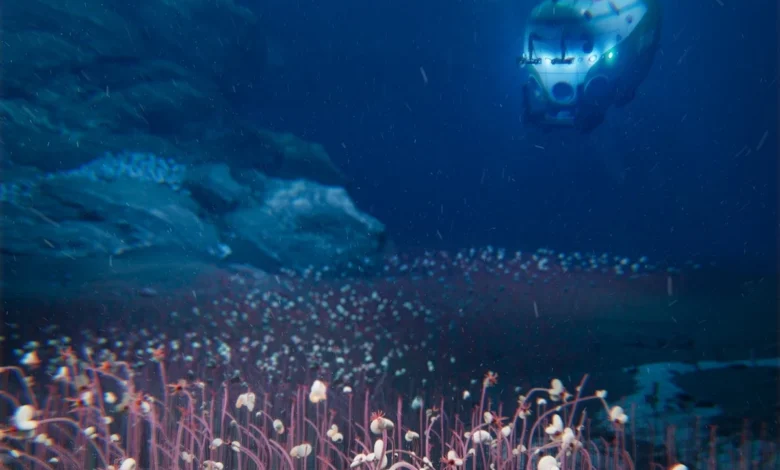
In a discovery that fundamentally alters the scientific understanding of the limits of life on Earth, researchers utilizing a Chinese manned submersible have documented the deepest and most extensive animal communities ever observed. Located nearly six miles beneath the ocean’s surface within the Mariana Trench and other Pacific hadal zones, these thriving ecosystems consist of thousands of mollusks, tubeworms, and other complex organisms. The findings, recently published in the journal Nature, reveal a "vibrant oasis" in an environment previously characterized as a biological desert, challenging long-held models regarding deep-ocean carbon cycling and the resilience of marine life under extreme pressure.
The study was conducted by a multi-disciplinary team from the Institute of Deep-sea Science and Engineering (IDSSE) under the Chinese Academy of Sciences. Using the state-of-the-art manned submersible Fendouzhe, the team conducted a series of 23 dives into the western Pacific’s most profound depths. Their observations focused on "hadal trenches"—v-shaped depressions in the ocean floor that exceed 6,000 meters (roughly 3.7 miles) in depth. Specifically, the team explored the Mariana Trench, the Kuril–Kamchatka Trench, and the western Aleutian Trench, uncovering chemosynthesis-based communities that span a staggering distance of over 1,553 miles.
The Hadal Frontier: Life at the Edge of the Abyss
The hadal zone represents the deepest region of the ocean, named after Hades, the Greek god of the underworld. It is an environment defined by total darkness, near-freezing temperatures, and hydrostatic pressures that exceed 1,000 times the atmospheric pressure at sea level. For decades, marine biologists believed that such conditions could only support sparse populations of scavengers or highly specialized single-celled organisms.
However, the Fendouzhe expedition provided visual and biological evidence to the contrary. The researchers identified massive colonies of siboglinid polychaetes (tubeworms) and bivalve mollusks thriving at depths ranging from 3.6 to 5.92 miles (5,800 to 9,530 meters). These animals do not rely on the "marine snow" of organic detritus falling from the sunlit surface. Instead, they are sustained by a process known as chemosynthesis.
"Hadal trenches, some of the Earth’s least explored and understood environments, have long been proposed to harbor chemosynthesis-based communities," the study authors noted. "Despite increasing attention, actual documentation of such communities has been exceptionally rare." This discovery marks the first time such a high density of macro-fauna has been recorded at these extreme depths, proving that complex life can flourish wherever a viable energy source is present.
The Mechanics of Life Without Sunlight
In most of the ocean, the food web begins with photosynthesis, where plants and phytoplankton convert sunlight into energy. In the absolute darkness of the Mariana Trench, this is impossible. The newly discovered communities rely instead on chemical energy derived from the Earth’s crust.
Isotopic analysis conducted by the research team revealed that these ecosystems are fueled by hydrogen sulfide-rich and methane-rich fluids. These chemicals are transported along geological faults that traverse deep sediment layers within the trenches. Microbes living within these sediments or in symbiotic relationships with the animals convert these chemicals into organic matter.
Lead author Xiatong Peng explained that methane is produced microbially from organic matter deposited in the trenches over geological timescales. The tubeworms, which can grow up to a foot long, tend to cluster around "snow-like" microbial mats that form near these chemical seeps. This creates a self-sustaining ecosystem that is largely independent of the world above.
"What makes our discovery groundbreaking is not just its greater depth—it’s the astonishing abundance and diversity of chemosynthetic life we observed," said study co-author Mengran Du, a marine geochemist with the IDSSE. "Unlike isolated pockets of organisms, this community thrives like a vibrant oasis in the vast desert of the deep sea."
Technological Achievement: The Fendouzhe Submersible
The success of the mission is largely attributed to the technical capabilities of the Fendouzhe (which translates to "Striver"). Developed by China to push the boundaries of deep-sea exploration, the vessel is constructed from a specialized titanium alloy designed to withstand the crushing pressures of the Challenger Deep—the deepest known point in the Earth’s seabed.

The submersible is equipped with high-definition cameras, robotic arms for sample collection, and sophisticated sensors for real-time chemical analysis. During the 2023 expeditions, the Fendouzhe captured footage of free-floating marine worms, spiky crustaceans, sea lilies, and sea cucumbers living alongside the primary colonies of clams and tubeworms. These visuals have provided scientists with an unprecedented look at the behavioral patterns of hadal species in their natural habitat.
"Diving in the submersible was an extraordinary experience—like traveling through time," Du remarked. "Each descent transported me to a new deep-sea realm, as if unveiling a hidden world and unraveling its mysteries."
A Timeline of Trench Exploration
The exploration of the Mariana Trench has been a slow and arduous process, spanning more than six decades of human effort:
- 1960: Jacques Piccard and Don Walsh became the first humans to reach the bottom of the Mariana Trench in the bathyscaphe Trieste. They stayed for only 20 minutes and observed very little due to silt clouds.
- 2012: Hollywood filmmaker James Cameron conducted a record-breaking solo dive in the Deepsea Challenger. He described the environment as "desolate" and "alien," noting a lack of large biological activity.
- 2019: Victor Vescovo’s "Five Deeps Expedition" reached the bottom multiple times, discovering new species of snailfish but focusing largely on the geological and record-breaking aspects of the dive.
- 2020–2024: The Fendouzhe missions represent a shift from "reaching the bottom" to "sustained scientific study," allowing researchers to spend hours on the seafloor documenting complex ecological interactions.
- 2025: The publication of the current study in Nature provides the first comprehensive evidence of widespread, large-scale animal colonies at these depths.
Broader Implications for Global Science and Policy
The discovery of these "chemical-eating" communities has significant implications for several fields of study, ranging from climate science to the search for extraterrestrial life.
Deep-Ocean Carbon Cycling
Current models of the Earth’s carbon cycle often overlook the role of hadal trenches. The discovery that these trenches host massive amounts of microbial and animal life suggests that the deep ocean may be a more significant carbon sink or processor than previously thought. The microbial production of methane and its subsequent consumption by these communities represent a massive, subterranean energy exchange that scientists are only beginning to quantify.
The Deep-Sea Mining Debate
The findings come at a critical time as the International Seabed Authority (ISA) debates the regulations for deep-sea mining. Several nations and corporations are eager to mine the seafloor for polymetallic nodules containing cobalt, nickel, and manganese—minerals essential for green energy technologies like electric vehicle batteries.
However, environmentalists and ocean scientists warn that the seafloor is not a barren wasteland but a fragile, ancient ecosystem. The discovery of vibrant colonies six miles down reinforces the argument that mining could cause irreversible damage to biodiversity that we are only just discovering. The "geological similarities" mentioned by Xiatong Peng suggest that if these communities exist in the Mariana and Aleutian trenches, they likely exist in other unexplored deep-sea zones targeted for mining.
Astrobiology and Life on Other Worlds
The existence of complex life sustained by chemosynthesis in high-pressure, lightless environments provides a potential blueprint for life on other planetary bodies. Scientists looking at Jupiter’s moon Europa or Saturn’s moon Enceladus—both of which are believed to have subsurface oceans—view the Mariana Trench as a terrestrial analog. If life can thrive six miles down in Earth’s ocean using only chemical energy, the prospects for finding similar life in the icy moons of our solar system are significantly bolstered.
Future Research Directions
While the Fendouzhe expedition has answered many questions, it has raised even more. The researchers noted that given the geological similarities across the Pacific Rim, these communities might be "more widespread than previously anticipated." Future missions will likely focus on mapping the full extent of these seeps and understanding the genetic adaptations that allow mollusks and worms to survive in such extreme conditions.
The study concludes that the deep sea remains one of the last true frontiers on Earth. As technology allows humans to spend more time at these depths, the traditional view of the ocean floor as a static, lifeless void is being replaced by a vision of a dynamic, chemically-powered engine that supports a vast and mysterious web of life. The work of the IDSSE and the findings published in Nature serve as a reminder that the most profound discoveries about our planet may still be hidden in its deepest, darkest corners.
Related posts: