Genesis Magma GT Concept Emerges as a High-Performance Halo Ambition for the Luxury Automaker

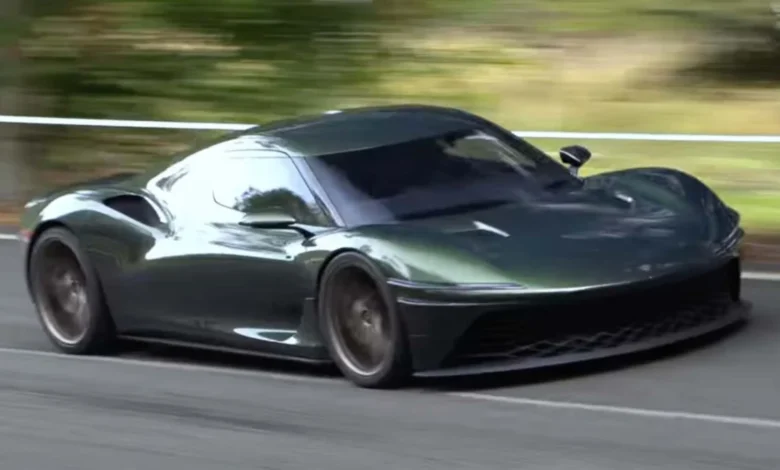
It has been less than a year since Genesis unveiled the Magma GT Concept, a sleek, mid-engine supercar that signaled a radical departure from the brand’s traditional focus on luxury sedans and SUVs. While the South Korean automaker has maintained a cautious stance regarding production, refraining from confirming a specific launch date or manufacturing timeline, the consistent presence of the vehicle at high-profile automotive events suggests that the Magma project is far more than a mere design study. A recent appearance at a hill climb event, captured by the YouTube channel NM2255 | Raw Car Sounds, has provided enthusiasts with a rare opportunity to observe the vehicle in motion, offering a glimpse into the raw potential of what could become the brand’s definitive halo car.
The footage, while brief, highlights the vehicle’s behavioral characteristics on the track. During the run, the driver navigated the greasy asphalt of the hill climb, with the car exhibiting signs of traction management challenges. Even at controlled, moderate speeds, the mid-engine coupe appeared to dance across the surface, hinting at the immense power reserves held within its drivetrain. The audible signature of the car—a deep, resonant twin-turbocharged V8 burble—stands in stark contrast to the electrified future toward which many of its luxury competitors are gravitating.
A Chronology of the Magma Evolution
The journey of the Magma GT began as an ambitious design exercise, but it quickly evolved into a multi-faceted performance initiative. In early 2024, Genesis first teased the concept, framing it as an investigation into how the brand could translate its "Athletic Elegance" design language into the realm of high-performance supercars.
By June 2024, the narrative shifted significantly. Genesis pulled the covers off a track-focused variant, the Magma GT3 Concept. This iteration featured a widened track, aggressive aerodynamic enhancements, and significantly enlarged air intakes designed to maximize cooling and downforce. By positioning the GT3 as an "independent study," Genesis signaled to the market that it was serious about exploring the technical requirements of a high-performance platform.
This development was followed shortly by public comments from key leadership. Charles Fuster, the Genesis Brand Director for Italy and France, explicitly stated in an interview with Motor1 Italy that the Magma project is "not a temporary exercise." While Fuster stopped short of providing a concrete production timeline, his assertion that the brand is eager to reach the market "soon" serves as the strongest indication yet that internal discussions regarding a production-ready halo car are well underway.
Technical Specifications and Performance Potential
The Magma GT is underpinned by a twin-turbocharged V8 engine, a powertrain configuration that firmly places the car in the echelons of modern supercar performance. Genesis has confirmed that the vehicle is engineered to produce approximately 800 horsepower. This output, if maintained in a production model, would allow the Magma to compete directly with established mid-engine titans from European and American manufacturers.
The interior design further complicates the vehicle’s identity. Revealed alongside the exterior updates in June, the cabin departs from the trend of screen-heavy, digital-first cockpits. Instead, it features a leather-draped, minimalist environment characterized by analog gauges and a focus on tactile luxury. This suggests that Genesis intends to position the Magma not merely as a track-day weapon, but as a "Grand Tourer" that balances high-speed capability with the comfort expected of the Genesis brand.
The Strategic Importance of a Halo Car
For a brand that has spent the last decade establishing its reputation for refinement and reliability, the introduction of a halo car is a strategic necessity. In the automotive industry, a halo car serves as the "tip of the spear"—a vehicle that embodies the brand’s engineering prowess and design philosophy, trickling down technological advancements to the rest of the lineup.
The decision to pursue a mid-engine platform is particularly significant. Mid-engine architectures are notoriously difficult and expensive to develop, requiring a complete departure from the front-engine, rear-wheel-drive platforms that currently define the Genesis GV and G-series lineups. By investing in this architecture, Genesis is signaling a transition toward being recognized as a performance-oriented luxury player.
Analysts suggest that the Magma GT could serve as a testing ground for future powertrain technologies. Whether the production version retains the internal combustion V8 or shifts toward a hybrid-assisted setup, the development of a bespoke chassis provides the brand with a foundation for future performance-oriented EVs or high-output luxury models.
Industry Context and Market Positioning
Genesis enters a crowded market segment. The mid-engine supercar space is dominated by legacy manufacturers with decades of racing heritage. However, Genesis has a unique advantage: its ability to rapidly iterate on designs, as evidenced by the quick transition from the initial GT concept to the track-focused GT3 variant.
Furthermore, the brand’s "One-of-One" program, which aims to provide bespoke design services to American buyers, indicates a desire to move toward a more exclusive, boutique-style manufacturing model. If the Magma GT were to be produced as a limited-run vehicle, it would align with this strategy, creating scarcity and elevating the brand’s prestige.
The skepticism surrounding the car’s potential production is largely rooted in the cost of entry. Developing a halo car from the ground up requires massive capital expenditure. However, rumors regarding the use of a shared chassis—with speculation even pointing toward comparisons with the C8 Chevrolet Corvette architecture—suggest that Genesis may be looking for ways to streamline development costs without compromising the vehicle’s performance integrity.
Challenges and Future Implications
Despite the optimism, the path to production remains fraught with technical and regulatory hurdles. Any vehicle reaching 800 horsepower must adhere to increasingly stringent global emissions standards and safety regulations. If the Magma GT is to be a global product, the powertrain must be optimized for efficiency without sacrificing the visceral sound and power that defines the concept.
Moreover, there is the question of the brand’s broader electrification strategy. Genesis has expressed a strong commitment to becoming an all-electric brand by the end of the decade. A high-performance, internal-combustion supercar could be seen as a "swan song" for the V8 engine, or perhaps the final piece of a transitionary phase before the brand pivots entirely to high-performance battery-electric vehicles (BEVs).
The Verdict on the Magma Project
The Magma GT Concept represents a pivotal moment for Genesis. By moving beyond digital renderings and taking the vehicle to live events, the automaker is effectively testing the market’s appetite for a true, no-compromise performance machine.
The sound of the V8 at the hill climb was more than just noise; it was an advertisement. It demonstrated that Genesis is capable of engineering a vehicle that is not only visually striking but also capable of participating in the same automotive culture as the most storied brands in the industry. As the brand continues to refine the Magma, the automotive community will be watching to see if the "soon" mentioned by leadership manifests as a production announcement.
For now, the Magma GT remains a concept, but one that is increasingly difficult to ignore. Whether it reaches production as a limited-edition supercar or serves as the design inspiration for the next generation of Genesis luxury performance vehicles, the project has already succeeded in its primary goal: elevating the perceived potential of the Genesis brand to a global stage. The transition from "concept" to "reality" is the next logical step, and based on the manufacturer’s recent activities, the foundation for that transition is already firmly in place.