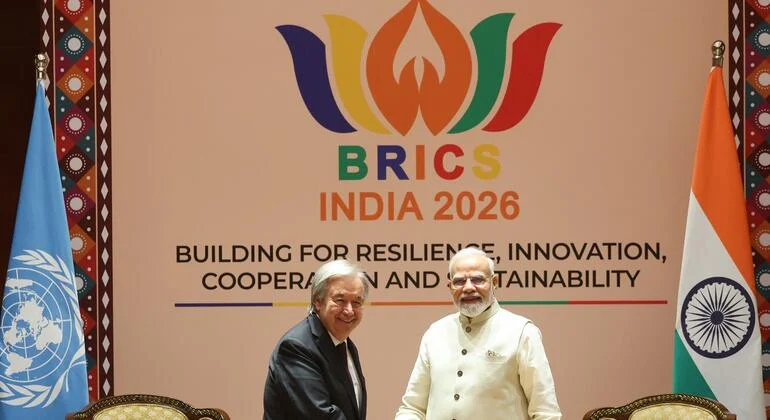
The architecture of international diplomacy and global finance is facing a profound reckoning as demographic shifts, economic momentum, and geopolitical power decisively migrate toward the Global South. Speaking before heads of state and high-ranking international officials at the summit in New Delhi, United Nations Secretary-General António Guterres delivered a sharp, unequivocal assessment of the modern global landscape. He argued that the institutional frameworks established in the wake of the Second World War are no longer fit for purpose, urging a comprehensive overhaul of legacy bodies such as the UN Security Council and the Bretton Woods institutions.
The high-stakes gathering, hosted by India, brought together the core membership of an influential bloc of major emerging economies—namely Brazil, Russia, India, China, and South Africa—alongside an expanding roster of newly admitted nations. Designed from its inception to counterbalance a post-war global order long dominated by Western capitals, the bloc has rapidly evolved from an informal economic acronym into a formidable geopolitical platform. This year’s summit also drew leadership from key international agencies, including the World Health Organization (WHO) and the World Trade Organization (WTO), underscoring the expanding scope of the alliance’s ambitions regarding global governance reform.
Reflecting Reality: The Imperative for Institutional Overhaul
At the heart of the Secretary-General’s address was a stark critique of institutional inertia. Pointing to the profound discrepancies between the mid-20th century and the modern era, Mr. Guterres emphasized that the structures governing international relations must adapt to contemporary realities.
"Today’s economic, demographic and geopolitical realities are not those of 1945," Mr. Guterres stated during his address. "Our institutional structures must reflect it."
For decades, critics have argued that the permanent membership of the UN Security Council—consisting of the United States, the United Kingdom, France, Russia, and China—fails to represent the contemporary distribution of global power, particularly the exclusion of major African, Latin American, and South Asian nations. By highlighting that the leaders assembled in New Delhi physically embody this shifting reality, the UN chief sought to frame institutional reform not as an act of charity by Western powers, but as a structural necessity for global stability.
The transition toward a multipolar world, Mr. Guterres suggested, should be welcomed rather than resisted. In a multipolar system, power is dispersed across several major centers rather than concentrated in a single hegemony or bipolar rivalry. However, he cautioned that multipolarity alone does not guarantee equity. Without deliberate and systemic reform of multilateral institutions, a fragmented power dynamic could lead to increased volatility, regional conflicts, and economic disenfranchisement.
Historical Background and the Evolution of the Bloc
To understand the weight of the New Delhi summit, one must look back at the origins of the grouping. Initially conceptualized in 2001 by Goldman Sachs economist Jim O’Neill under the acronym BRIC—referring to Brazil, Russia, India, and China—the grouping transitioned from a theoretical investment concept into a formal diplomatic coalition in 2009. South Africa joined the fold the following year, transforming the acronym into BRICS.
For over a decade, the bloc focused primarily on economic cooperation, establishing the New Development Bank as an alternative to the International Monetary Fund and the World Bank. However, in recent years, the coalition has taken on an increasingly geopolitical character. The decision to invite additional nations—including major energy producers and regional heavyweights in the Middle East and Africa—marked a turning point in its expansion strategy.
The inclusion of these new members has amplified the bloc’s collective economic footprint. Together, these nations now account for a substantial share of global gross domestic product, a commanding majority of the world’s population, and a dominant position in global commodity and energy markets. Consequently, their demands for greater voting power in international financial institutions and a permanent seat at the top tables of diplomacy have grown increasingly assertive.
Four Pillars of Inclusive Global Growth
Moving beyond institutional critique, Mr. Guterres outlined four critical priorities essential for fostering inclusive global growth and ensuring that the transition to a multipolar world benefits developing and developed nations alike: financing, technology, climate justice, and peace.
The first priority centers on international finance and development assistance. Developing nations, the Secretary-General noted, require massive international support to achieve the United Nations’ Sustainable Development Goals (SDGs). Years of economic shocks—including the lingering aftermath of the COVID-19 pandemic, inflationary pressures, and soaring sovereign debt burdens—have left many emerging and low-income economies starved of capital. Mr. Guterres reiterated his call for multilateral development banks to become significantly larger, better capitalized, and bolder in their lending strategies to prevent a lost decade of development.
The second priority addresses the digital divide, specifically the explosive growth of artificial intelligence (AI). While AI holds immense potential to revolutionize medicine, agriculture, and industry, its benefits remain dangerously concentrated.
"Its power sits with a few companies, in a few countries," Mr. Guterres warned. "Unchecked, the AI divide will widen every other divide—in income, in opportunity, in security, and in sovereignty."
Without international regulatory frameworks and equitable access to technological infrastructure, the AI revolution risks turning into a primary driver of global inequality, leaving the Global South to bear the socio-economic disruptions of automation without reaping its rewards.
Confronting Climate Realities and Resource Extraction
Perhaps the most urgent and hard-hitting component of the Secretary-General’s address focused on the escalating climate crisis. Against the backdrop of worsening environmental disasters worldwide, Mr. Guterres issued a severe warning regarding global temperature trajectories and extreme weather events.
"Scorching heat, devastating glacier melt, raging wildfires, devastating floods are all a preview," he remarked, adding that the arrival of a supersized El Niño phenomenon would only exacerbate climatic stress as the planet inches closer to breaching the critical 1.5-degree Celsius threshold above pre-industrial levels.
Wealthy nations, historically responsible for the vast majority of cumulative greenhouse gas emissions, were urged to immediately honor their long-standing financial commitments. This includes delivering on promises of $300 billion annually in climate finance, tripling adaptation funding, and fully operationalizing the loss and damage fund agreed upon at recent UN climate summits. Furthermore, Mr. Guterres turned his attention to the predatory extraction of critical minerals—such as lithium, cobalt, and nickel—which are vital for the green energy transition. Directing his remarks at both multinational corporations and supplier states, he declared bluntly: "Enough plundering."
Peace, Security, and Upholding the UN Charter
In the realm of global security, Mr. Guterres addressed the cascading crises destabilizing international stability, explicitly pointing to ongoing conflicts in Gaza, the broader Middle East, Ukraine, and Sudan. The resurgence of major state-on-state conflict and brutal civil wars, he argued, stems from a dangerous erosion of adherence to international law.
He issued a stern reminder to all member states to strictly uphold the principles enshrined in the United Nations Charter. These foundational tenets include sovereign equality, the protection of territorial integrity, and the peaceful settlement of disputes. The failure of major powers to respect these norms has created a climate of impunity, emboldening aggressors and severely undermining the credibility of collective security mechanisms.
Implications and the Road Ahead
The statements delivered by the UN Secretary-General in New Delhi capture a definitive moment in modern history. The post-Cold War unipolar era, defined by Western economic and military dominance, has definitively given way to a fragmented, multipolar reality. However, the institutions designed to manage global affairs have struggled to adapt, resulting in institutional gridlock and a crisis of multilateralism.
Political analysts note that while emerging economies are eager to reshape global governance to reflect their growing economic weight, internal divergences within blocs like BRICS—ranging from political rivalries between member states to contrasting economic models—pose significant challenges to unified action. Nevertheless, the convergence of major developing nations demanding institutional reform signals an irreversible structural shift in international diplomacy.
In his closing remarks, Mr. Guterres framed this transitional period not as a zero-sum game, but as a collective responsibility. He emphasized that as the world moves toward multipolarity, all nations—traditional and emerging powers alike—must work in concert to safeguard a multilateral system with the United Nations at its core. Whether the established global powers will heed this call for reform, or whether parallel institutions will continue to rise outside the traditional Western-led framework, will define the trajectory of international relations for decades to come.