The 1953 Cadillac Elegante One-Off Concept Car Sells for a Record-Breaking 1.275 Million Dollars at Auction

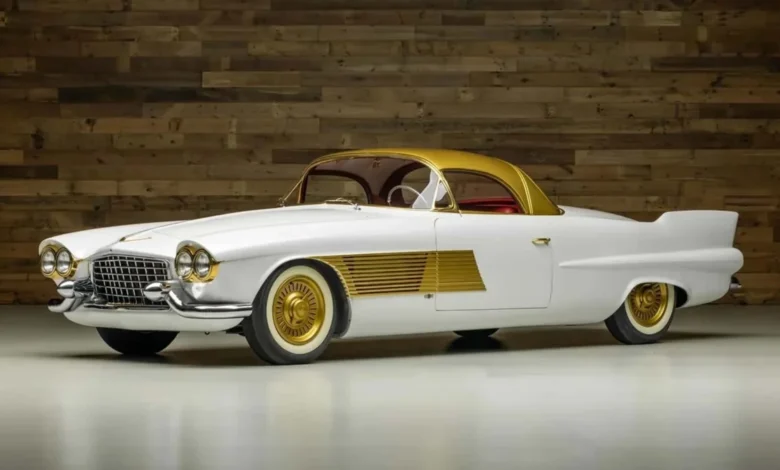
Kruse Auctions achieved a monumental milestone in the collector car market this week in Auburn, Indiana, as the rare, gold-plated 1953 Cadillac Elegante shattered the record for the most expensive Cadillac ever sold at a public auction. With a final hammer price of $1,275,000, the one-off grand tourer eclipsed the previous high-water mark of $940,000, which was established in 2023 by a 1934 V16 Fleetwood Aerodynamic Coupe. The sale of the Elegante represents a significant shift in collector interest, highlighting a growing appetite for bespoke, coachbuilt American automotive history.
The Origin and Vision of the Elegante
The story of the Elegante begins in the early 1950s, a golden era for American automotive design where manufacturers and independent coachbuilders frequently experimented with the boundaries of luxury. The project was spearheaded by the renowned designer Albrecht von Goertz, who would later achieve global fame for his work on the iconic BMW 507. During his tenure as a consultant, von Goertz sought to create a vehicle that blended American mechanical reliability with the refined, artisanal aesthetic of European coachbuilding.
Built upon the robust Series 62 chassis, the Elegante was not a product of an assembly line. Instead, it was commissioned as a singular statement piece. To bring the vision to life, the project was entrusted to the Italian workshop Carrozzeria Motto. The construction process was exhaustive, requiring 30 months of intensive hand-forming of the aluminum bodywork. At the time, the development cost reached approximately $30,000—a staggering figure for a single vehicle in the 1950s, equivalent to over $350,000 in contemporary currency. This extreme financial investment effectively precluded the possibility of mass production, cementing the Elegante’s status as a true one-off concept.
A Masterclass in Opulence
The aesthetic language of the Elegante is defined by a restrained but profound sense of opulence. Unlike many postwar customs that relied on heavy chrome accents and excessive fins, the Elegante utilized 24-karat gold plating to accentuate its lines. The gold detailing is applied with surgical precision, adorning the door handles, the windshield frame, and various custom bronze components. This is paired with a sophisticated pearlescent white exterior finish, complemented by a gold-painted roof that provides a striking visual contrast.
The interior continues this theme of uncompromising quality. The cabin is appointed in deep, rich burgundy Italian leather, creating a warm and inviting atmosphere. Perhaps the most distinct feature of the dashboard is the Lucite steering wheel, which houses an illuminated Saint Christopher medallion—a hallmark of mid-century high-end customization.
Beneath the hood, the Elegante is powered by a 5.4-liter overhead-valve V8 engine, producing approximately 210 horsepower. While modern performance metrics would categorize this as modest, in 1953, it provided ample motivation for a grand touring vehicle. The engineering was further bolstered by an innovative electro-hydraulic system designed to operate the retractable hardtop, a feature that was significantly ahead of its time for the domestic market.
A Tortuous Timeline and Restoration
Following its completion, the Elegante made its public debut at the 1955 New York International Auto Show, where it drew significant attention from the automotive press and industry executives. Despite the positive reception, the planned production run of 10 units never materialized, leaving the prototype as the sole surviving example.

The decades following its debut were not entirely kind to the vehicle. In a twist of fate, the car was severely damaged during the catastrophic landfall of Hurricane Andrew in the early 1990s. The destruction threatened to erase the car from history entirely, but it instead sparked a massive, multi-year salvage and restoration effort. This meticulous process spanned 16 years, with technicians and restorers working to source original parts and replicate the specific Italian craftsmanship that defined the car’s construction. The restoration was finally completed in 2014, returning the Elegante to its original show-stopping configuration.
When it crossed the block at Kruse Auctions, the vehicle arrived with a documented history, a pristine 4,331-mile odometer reading, and a clear chain of ownership. This provenance, combined with the fact that it had remained out of the public eye for roughly 73 years, created a "perfect storm" for bidders looking for a unique asset with an untraceable public history.
Market Implications and Collector Sentiment
The $1.275 million result serves as a bellwether for the current state of the classic car market. While high-end Ferraris and Duesenbergs have long commanded seven-figure sums, the appreciation for American concept cars of the 1950s has been more measured. The gap of over $300,000 between the Elegante and the previous Cadillac record holder indicates that collectors are increasingly looking for "unicorn" vehicles—cars that have unique design histories and documented, verifiable stories.
"The Elegante is not a loud car in terms of design, but it is a masterclass in inconspicuous luxury," noted a spokesperson from Kruse Auctions following the sale. This sentiment aligns with current trends where rarity and historical pedigree often outweigh sheer horsepower or racing success. The sale also serves as a reminder to enthusiasts and collectors alike that historical value is not always found in production models. There are countless custom projects and period-built customs tucked away in private collections or garages that may hold significant market value if their history is properly researched and documented.
Future Perspectives
As the auction hammer fell, the sale of the 1953 Cadillac Elegante signaled a potential shift in how enthusiasts value the "lost" concepts of the 1950s. The car is now widely considered the definitive example of bespoke American luxury, serving as a benchmark for future auctions. For the new owner, the purchase is not merely an acquisition of a vehicle, but the stewardship of a piece of automotive history that bridges the gap between American industrial power and Italian artistic finesse.
The success of this sale will likely embolden other auction houses to seek out similar "missing" prototypes and coachbuilt specials. In a market often dominated by high-volume classics, the Elegante proves that there is a deep, sophisticated demand for vehicles that represent the singular, uncompromising vision of a designer. As the automotive world continues to shift toward electrification and automation, these relics of an era defined by hand-hammered aluminum and 24-karat gold become increasingly rare, and consequently, increasingly valuable.
For the broader collecting community, the Elegante serves as a lesson in patience and persistence—both in terms of the 16-year restoration process and the decades of wait-time required for the car to finally be appreciated at a public forum. It is an artifact that validates the pursuit of the unique, the obscure, and the undeniably beautiful.