The automotive landscape has undergone a monumental structural shift over the past several years, driven by tightening global emissions regulations, corporate average fuel economy mandates, and the rapid electrification of mainstream transport. For decades, American muscle car culture relied heavily on the chest-thumping, low-end rumble of naturally aspirated or supercharged V8 engines—specifically Chrysler’s legendary Hemi architecture. When Dodge announced that its next-generation Charger would abandon the traditional V8 formula in favor of an all-electric variant alongside a 3.0-liter twin-turbocharged straight-six engine known as the Hurricane, purists reacted with immediate and widespread resistance. Internet forums and enthusiast communities heavily criticized the brand for supposedly compromising its core identity, mourning the loss of the traditional pushrod heartbeat.
Yet, looking past the digital discourse and examining the hardware on the pavement reveals a far more nuanced reality. The 2026 Dodge Charger R/T, priced at a base MSRP of $51,995 and scaling to $55,980 with options and destination charges, offers a dynamic blend of performance, daily drivability, and multi-role utility. It is an automobile engineered to survive a changing regulatory environment while attempting to retain the aggressive styling, rear-wheel-drive antics, and straight-line punch that built the modern Dodge brand. Rather than serving as a disappointing compromise, the inline-six-powered Charger R/T introduces a versatile package that redefines what a contemporary American muscle car can achieve in everyday life.
Evolution of the Species: The Background Context
To understand the engineering rationale behind the latest Charger generation, one must look at the pressures facing Stellantis and domestic automotive manufacturers as a whole. The previous-generation Charger and Challenger, while commercially successful for a remarkably long production run spanning over a decade, relied on a platform that could no longer meet upcoming fuel economy standards or accommodate modern multi-energy powertrains safely and efficiently. Dodge faced a critical fork in the road: phase out the nameplate entirely or reinvent it from the ground up.
The automaker chose reinvention. By developing a flexible new platform designed to house both high-voltage battery-electric systems and internal combustion engines, Dodge charted a path forward. The introduction of Stellantis’s Hurricane twin-turbo inline-six was the cornerstone of this combustion strategy. Designed to deliver V8-matching or V8-beating power outputs with superior thermal efficiency and lower tailpipe emissions, the Hurricane engine became the new standard bearer for Dodge’s performance ambitions. The R/T specification represents the entry point to this turbo-six world, delivering 420 horsepower and 468 lb-ft of torque via an eight-speed automatic transmission.
Exterior Styling and Public Reception
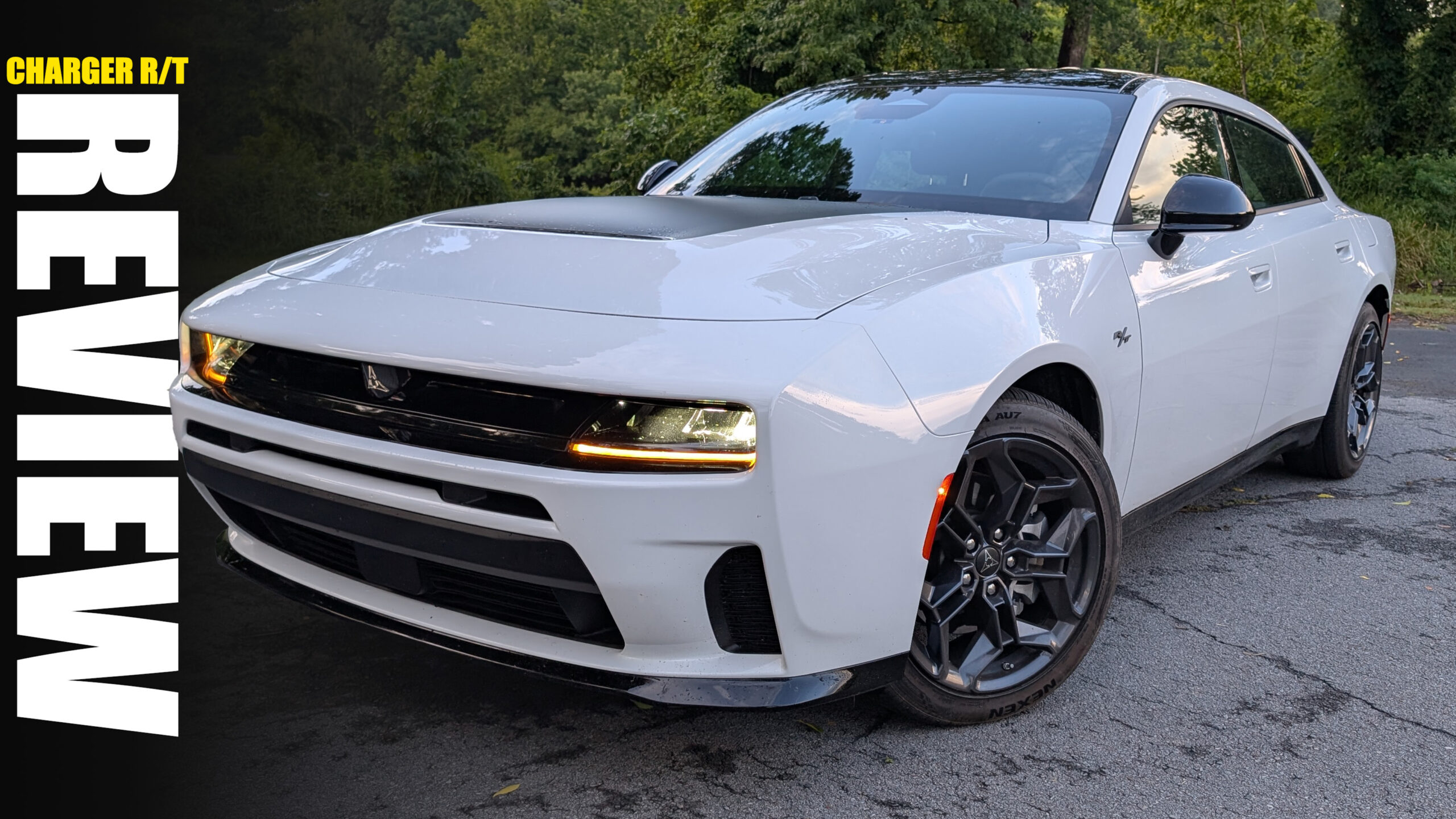
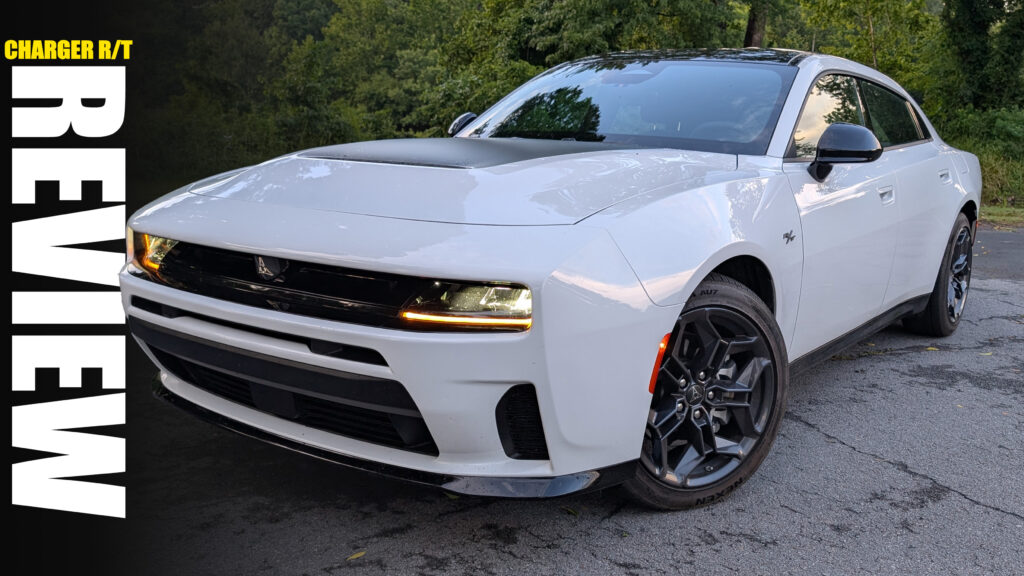
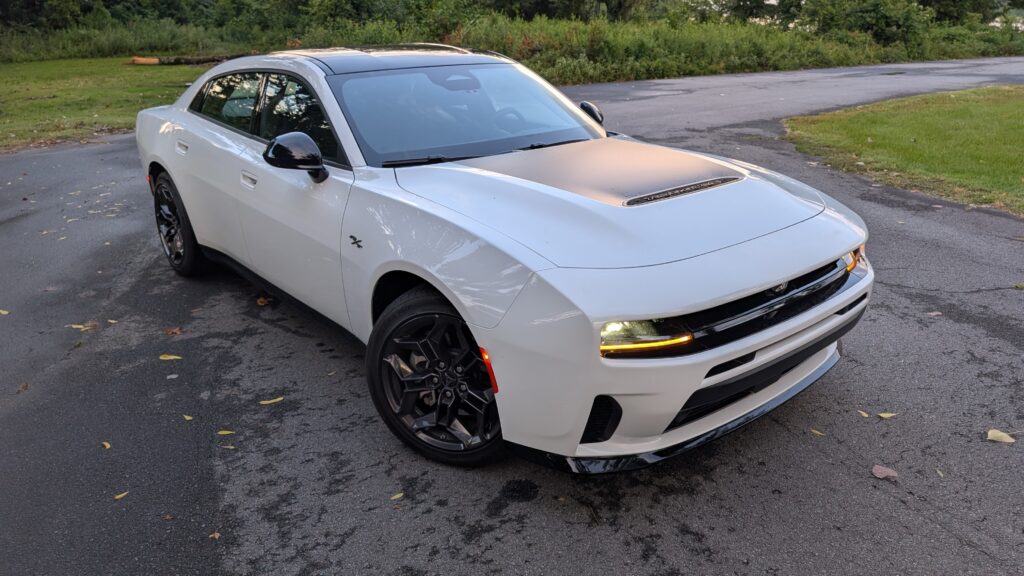
One of the most striking aspects of the new Charger R/T is its visual presence on public roads. Dodge’s design team deliberately avoided a lazy recreation of the past. Instead, the vehicle adopts a wide, low, and imposing stance characterized by clean surfacing and sharp proportions. Finished in hues like White Knuckle with the aggressive Blacktop aesthetic package, the car commands attention wherever it travels.

Interestingly, while internet forums heavily criticized the absence of a V8 engine, ordinary motorists and pedestrians reacted with enthusiastic curiosity throughout real-world testing. Passersby frequently approached the car to inspect its design, ask about its specifications, and admire its stance. This stark disconnect between online purists and everyday consumers highlights the broad appeal of the Charger’s new sheet metal.
However, manufacturing consistency remains an area for refinement. Panel gaps observed on evaluation models lacked uniform precision. While these minor aesthetic inconsistencies did not affect structural integrity or mechanical performance, buyers spending upwards of $55,000 expect tighter quality control and seamless exterior assembly.

Cabin Comfort, Layout, and Packaging Ingenuity
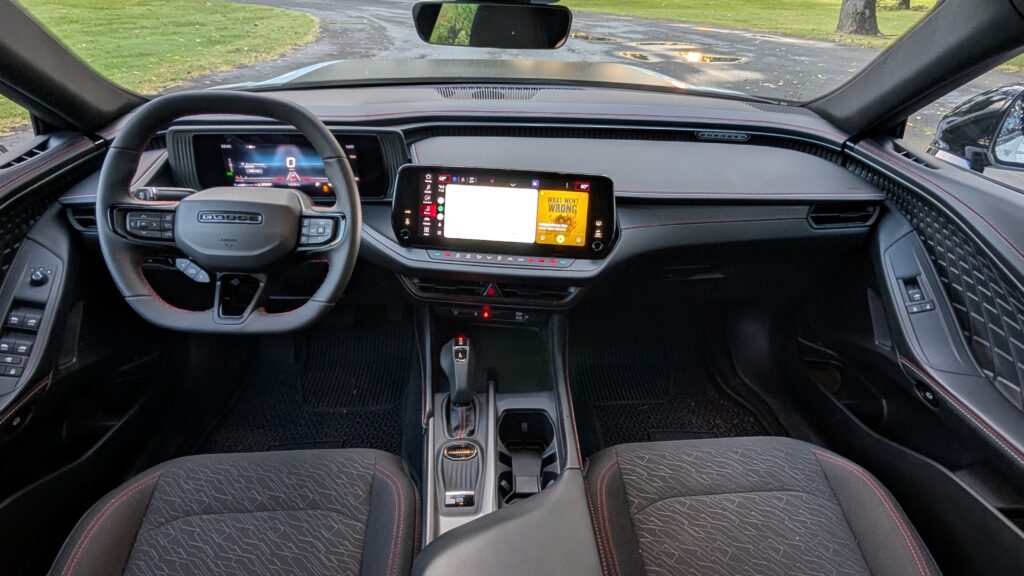
Stepping inside the 2026 Dodge Charger R/T reveals an interior that balances functional performance with modern digital integration. Dodge resisted the industry-wide temptation to transform the entire dashboard into an oversized television screen. Instead, the central Uconnect infotainment display remains modest in scale, prioritizing the driver’s focus while offering seamless wireless Apple CarPlay and Android Auto connectivity.
Material quality strikes a pragmatic balance. The cabin features textured plastics and red contrast stitching that add visual theater without pretending to be a European luxury sedan. The front seating provides ample comfort for long journeys, though enthusiasts might desire additional lateral bolstering for aggressive cornering maneuvers.

Packaging efficiency is where the new Charger truly separates itself from its predecessors. Standing 6-foot-6, evaluators noted that adult passengers can comfortably occupy the rear seats behind an equally tall driver. Because both the two-door coupe and four-door sedan configurations share identical rooflines and fundamental packaging, rear-seat headroom and legroom remain impressively generous regardless of door count.
Furthermore, the integration of a hatchback cargo configuration dramatically expands the vehicle’s utility. With the rear seats folded flat, the cargo bay easily swallows bulky items—such as a full-size mountain bike with its front wheel removed—offering a level of practicality typically reserved for compact crossovers rather than high-horsepower performance machines.
Powertrain Performance and Drivetrain Flexibility
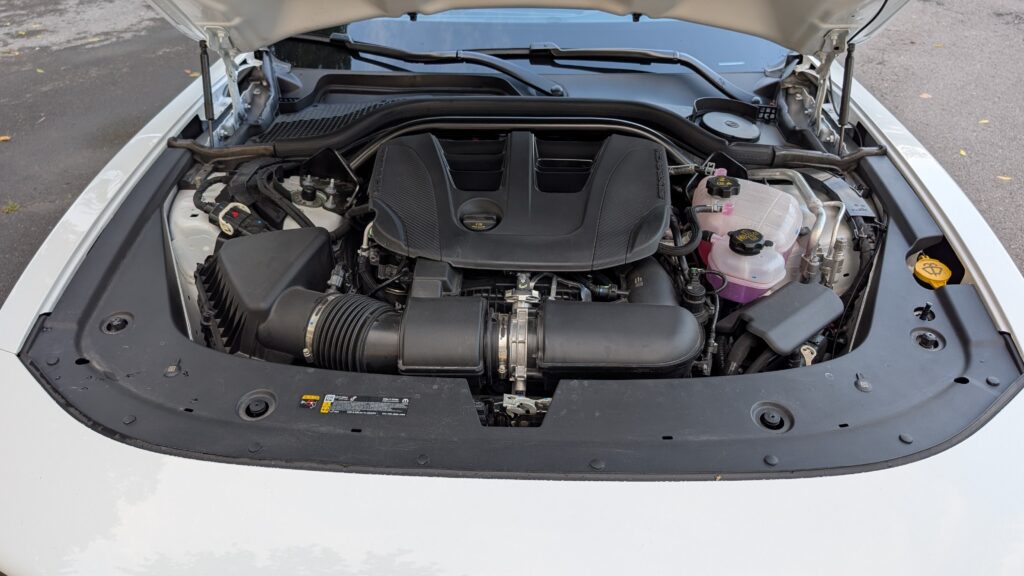
At the mechanical heart of the R/T is the Standard Output 3.0-liter twin-turbo Hurricane inline-six. While throttle response lacks the instantaneous, razor-sharp immediacy of a naturally aspirated V8, the turbo-six delivers robust, predictable power that builds strongly toward the upper reaches of the tachometer. The exhaust note, while missing the deep bass rumble of a Hemi V8, develops a characterful sound as the engine approaches its redline.
The accompanying eight-speed automatic transmission presents a mixed experience. Under normal driving conditions, downshifts can feel sluggish when immediate acceleration is requested. Activating Sport mode sharpens transmission behavior considerably, though it simultaneously highlights the relaxed calibration of the standard mode. More perplexingly, test models lacked a dedicated manual gear selection mechanism—such as paddle shifters—which feels like a notable omission for a 420-horsepower performance vehicle.

Where the drivetrain redeems itself is its sophisticated traction management system. As a standard all-wheel-drive vehicle, the Charger R/T provides immense grip and security in adverse weather conditions. However, Dodge engineered the system to allow drivers to completely disconnect the front axle, transforming the vehicle into a pure rear-wheel-drive machine. This feature is far more than a marketing gimmick; it fundamentally alters the car’s dynamic character, enabling spirited rotation and traditional rear-drive handling dynamics on demand.
Driving Dynamics, Ride Quality, and Efficiency
Weighing in as a substantial automobile, the Charger R/T cannot entirely mask its physical mass. When pushed hard through tight technical corners, drivers are constantly reminded of its heavy footprint. Nevertheless, the chassis engineering manages this weight remarkably well. The steering offers reassuring weight and consistency that adjusts intelligently based on the selected drive mode. Braking performance remains linear, inspiring confidence during spirited road driving without exhibiting premature fade.
Ride quality represents a major victory for daily usability. The suspension absorbs road imperfections smoothly, making long highway commutes quiet and relaxed. When the driver desires a more visceral experience, Sport mode introduces heightened feedback and engine theater.
Perhaps the most surprising attribute of the Charger R/T is its fuel efficiency. Despite being rated by the EPA at 17 mpg city, 26 mpg highway, and 20 mpg combined, real-world mixed driving frequently yields efficiency matching or slightly exceeding the 26 mpg highway benchmark. For a 420-horsepower all-wheel-drive muscle car of this physical scale, achieving such economy during everyday commuting is a notable engineering achievement.
Market Implications and Competitive Positioning
The primary internal challenge facing the Charger R/T comes from within the Dodge lineup itself. The Charger Scat Pack, equipped with the High Output Hurricane engine producing 550 horsepower, commands a starting price that sits uncomfortably close to a well-optioned R/T. For buyers whose primary metric is absolute performance, spending the marginal difference for the Scat Pack is a logical step.
Yet, the R/T occupies a unique sweet spot. It bridges the gap between everyday comfort, superior fuel efficiency, winter-weather all-wheel-drive capability, and rear-wheel-drive performance theater. While the missing V8 and lack of manual paddle shifters remain valid criticisms for purists, judging the 2026 Dodge Charger R/T strictly by what it is—rather than what critics wish it were—reveals an exceptionally capable and versatile American performance car.