In the marginalized neighborhood of Ibura de Baixo, nestled within the South Zone of Recife, the day for 27-year-old Jeyne Araújo begins at 4 a.m. While the rest of the Pernambuco state capital remains dormant, Araújo is already engaged in a grueling ritual: dragging heavy buckets and plastic drums across her floor. This is not a choice, but a necessity born of profound scarcity. In her home, running water is a fleeting luxury, arriving for only six hours daily. She must stockpile every drop before the pipes inevitably run dry, leaving her family to navigate the remainder of the day in a state of suspended animation.

The water she manages to collect is far from the pristine resource promised by public utility services. It often carries a pungent chemical odor, likely an over-chlorination byproduct, and is frequently unusable for drinking or cooking. "It arrives so full of chlorine that you can’t do anything with it," Araújo explains. The consequences of this substandard supply are not merely inconvenient; they are hazardous. Her 9-year-old son, Wesley, spent six months suffering from chronic vomiting and severe abdominal pain, a medical ordeal that doctors at Recife’s Areias Hospital linked directly to the consumption of food prepared with contaminated tap water. To protect her child, Araújo is forced to redirect a significant portion of her monthly Bolsa Família stipend—a vital welfare benefit of 950 reais (approximately $180)—to purchase bottled water, further tightening the constraints on an already fragile household budget.
The Geography of Inequality
Araújo’s struggle is a poignant case study of what sociologists and environmental justice advocates term "water racism." In Recife, the data suggests that a resident’s access to the most basic of human needs is dictated by a rigid intersection of race, gender, and postal code. An extensive analysis conducted by Mongabay, which cross-referenced supply schedules from the Pernambuco Sanitation Company (Compesa) with 2022 census microdata, reveals a map of systemic exclusion.

The data indicates that of the 311 locations surveyed across the city in July 2026, 236 suffer from chronic supply interruptions. These shortages are not distributed randomly; they disproportionately impact Black women living in neighborhoods where the average monthly per capita income falls between 1,100 and 2,300 reais ($206–$430).
According to benchmarks established by the National Water and Basic Sanitation Agency (ANA), intermittent service is defined as any disruption lasting six hours or longer. The agency’s regulatory goal is for water to be available for more than 18 hours per day, totaling over 540 hours in a 30-day month. Yet, the peripheral areas of Recife receive, on average, only 17% of this benchmark. Ibura, where Araújo resides, stands as one of the most neglected areas, receiving a mere 91 hours of water per month. In stark contrast, affluent, predominantly white neighborhoods like Boa Viagem, Apipucos, and Espinheiro enjoy near-uninterrupted service, recording upwards of 700 hours of supply per month.

A History of Vulnerability and Climate Risk
The crisis in Recife is compounded by the city’s extreme vulnerability to climate change, a reality that has turned water scarcity into a life-threatening scenario. The neighborhood of Linha do Tiro serves as a harrowing example. Perched on the hillsides of the North Zone, it is classified by Civil Defense authorities as an area of high (R3) to very high (R4) hydrological risk. Residents here live under the constant shadow of potential landslides and flooding, yet they remain tethered to an unreliable water infrastructure that frequently leaves them without the means to clean their homes or maintain basic hygiene during emergencies.
The scars of the 2022 floods remain fresh. During that disaster, Araújo lost her partner when he encountered a live electrical wire submerged in floodwaters—a tragedy she attributes to a delayed emergency response. Despite urgent pleas, she claims utility workers took ninety minutes to de-energize the power grid. When questioned regarding the incident, the electricity distributor Neoenergia did not provide a formal response.

The Shift Toward Privatization: Promises and Perils
In April 2026, the Pernambuco state government, led by Governor Raquel Lyra, entered into a partial concession contract with BASA Saneamento. The agreement, valued at 17.4 billion reais ($3.3 billion), covers 151 municipalities and aims to address the state’s chronic sanitation deficits. However, the deal has ignited a firestorm of controversy.
Critics, including Anderson Quadros, president of the Association of Higher-Level Employees of Compesa (Procompesa), argue that the contract essentially privatizes the most lucrative segments of the utility—distribution and sewage collection—while leaving the costly, high-risk operations of water production and extraction in the hands of the state-run Compesa. Quadros warns that the profit-driven motives of private operators may ignore the engineering and logistical challenges of providing water to the steep, difficult-to-reach hillsides where the most vulnerable populations reside.

"People say the private sector will invest 19 billion reais, but this target does not appear in any contractual clause. It is merely a reference figure," Quadros asserts. He highlights the precedent set by previous public-private partnerships in Greater Recife, where, over a 13-year period, private firms failed to expand infrastructure into the hillside communities, focusing instead on already profitable flat-land areas.
In response, BASA Saneamento has defended the contract, stating that it mandates 15.4 billion reais in investments over 35 years and that funds will be allocated according to technical priorities. The Pernambuco state government has also rejected claims of discriminatory service, asserting that the contract contains no provisions allowing for the neglect of certain areas based on economic profitability.

The Environmental and Economic Limits
The fundamental challenge facing Recife is a dwindling natural supply. Pernambuco possesses the lowest per capita water availability of any Brazilian state, with reserves comparable to those found in arid, desert climates. The region relies on seven primary dams, including the Pirapama and Tapacurá reservoirs, and the Beberibe aquifer. Maria do Carmo Sobral, a civil engineer and professor at the Federal University of Pernambuco (UFPE), warns that the city has reached the physical limits of its surface water extraction.
"We have no other river to tap within a 40- to 50-kilometer radius," Sobral notes. She emphasizes that the focus must shift from mere expansion to the restoration of riparian forest buffers around reservoirs and a massive reduction in the 50% of treated water currently lost to leaks in the aging distribution network.

A Cycle of Lost Dignity
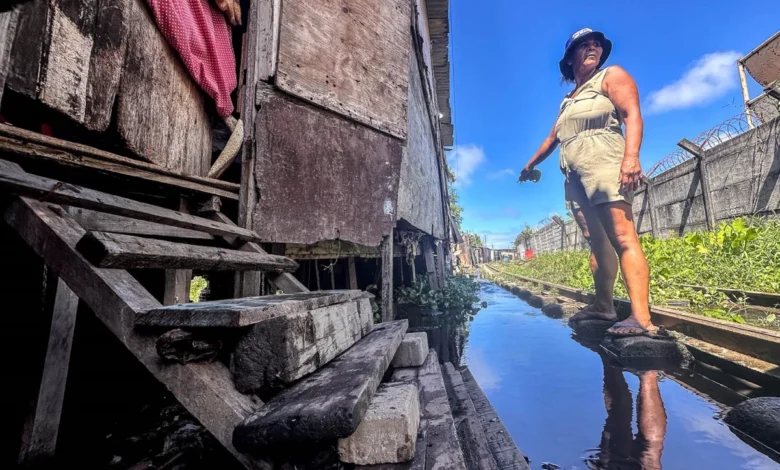
For residents like 51-year-old Alessandra Maria da Silva, who lives in the informal settlement of Cacique Chicão, these policy debates feel lightyears away from her daily reality. Living in a wooden stilt shack atop abandoned railway tracks, she navigates a landscape of raw sewage and stagnant water. Her reliance on a decommissioned main line, which provides only a weak trickle of water that stops completely by 8 p.m., is a testament to the failure of basic infrastructure.
Similarly, in Linha do Tiro, 44-year-old Joana manages her household’s water supply through a grueling, clandestine system. She and her children often make the treacherous trek down steep, broken asphalt to fetch water from a neighbor’s well, a task necessitated by rationing cycles that can leave them dry for up to 15 consecutive days.

The human cost of this crisis is immeasurable. Whether it is Maria do Bom Parto, who pooled family savings to drill an uncertain tube well for her neurodivergent son, or Jeyne Araújo, who must choose between food and safe water for her child, the residents of Recife’s peripheries are bearing the brunt of a systemic failure. As the state moves forward with its privatization plans, the question remains whether these changes will finally bridge the divide between the city’s affluent enclaves and its thirsty hillsides, or if the cycle of water scarcity will continue to deepen, further entrenched by the cold calculus of profit. For the people of Ibura and Linha do Tiro, the wait for water is a wait for the most basic recognition of their dignity as citizens.