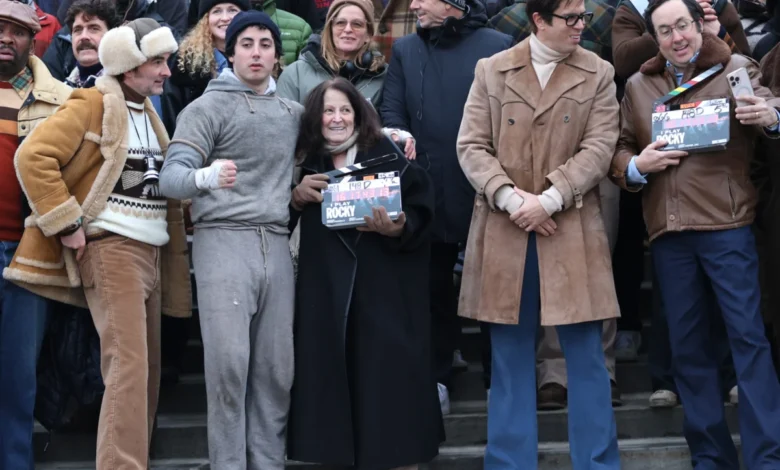
P.J. Byrne has carved out a distinct and reliable presence in contemporary American cinema and television, establishing himself as a consummate character actor whose contributions consistently transcend traditional supporting roles. Often categorized by audiences as an archetypal "hey, I love that guy!" performer, Byrne possesses a rare ability to ground high-concept comedies and heavy dramas alike. From his memorable, manic corporate energy in Martin Scorsese’s The Wolf of Wall Street to his period-accurate styling in Damien Chazelle’s Babylon, and his recent work in Peter Farrelly’s biographical drama I Play Rocky alongside the long-awaited hybrid feature Coyote vs. Acme, Byrne approaches his craft with a rigorous dedication to collaboration and script enhancement.

Rather than viewing acting as a competitive zero-sum game where individual performers vie for attention, Byrne maintains a philosophy rooted in collective elevation. In his view, a scene’s success relies on mutual support, preparation, and an understanding of the overarching directorial vision. This philosophy has guided a career that spans over two decades, earning him the respect of premier auteurs including Mike Nichols, Martin Scorsese, and Peter Farrelly. As he steps into prominent
supporting configurations, Byrne continues to refine a process that merges meticulous preparation with spontaneous, high-impact improvisation.

The Anatomy of Preparation and Collaboration
Byrne’s methodology diverges significantly from actors who rely solely on spontaneity during a take. In interviews discussing his career trajectory, the actor has detailed an intensive pre-production routine that involves immersing himself in a character’s mindset weeks before principal photography begins. This solitary immersion serves a specific purpose: to identify structural gaps in a scene where a character can subtly shift the momentum, inject humor, or reinforce the thematic stakes without overshadowing the primary narrative arc.
This disciplined approach was shaped early in his career by masterclass directors. A notable turning point occurred when filmmaker Mike Nichols observed Byrne’s work in Charlie Wilson’s War (2007) and encouraged him to exercise total creative freedom. That endorsement provided the psychological foundation Byrne later utilized to improvise complex, unscripted monologues in The Wolf of Wall Street.

Industry peers and directors frequently praise Byrne for his stamina and positive on-set demeanor—qualities he views as professional obligations rather than mere pleasantries. By maintaining high energy late into production cycles and prioritizing interpersonal respect among cast and crew members, Byrne acts as a stabilizing force within complex film sets. He emphasizes that a collaborative environment directly correlates with artistic quality, minimizing friction and allowing entire ensembles to perform at their highest potential.
Stepping Into Hollywood History with I Play Rocky
In Peter Farrelly’s semi-biographical feature I Play Rocky, Byrne takes on the role of legendary super-producer Irwin Winkler. The film chronicles the improbable, obstacle-laden production of the 1976 sports classic Rocky, focusing heavily on Sylvester Stallone’s tenacious refusal to sell his screenplay unless he was permitted to star in the title role. Supported by producers Winkler and Robert Chartoff—portrayed by Toby Kebbell—Stallone’s vision survived studio skepticism, stringent budget constraints, and industry doubt to eventually secure the Academy Award for Best Picture.

Byrne’s portrayal of Winkler strikes a delicate balance between historical accuracy and narrative accessibility. Working opposite Anthony Ippolito—who stars as a young Sylvester Stallone—Byrne infuses the veteran producer with a grounded, deadpan wit that anchors the frantic corporate negotiations of 1970s Hollywood. The dynamic between Byrne and Kebbell forms the backbone of the production team’s narrative arc within the film. Despite having minimal time to establish a working relationship prior to shooting, the two actors cultivated an unspoken chemistry that mirrored the genuine synergy of long-standing creative partners.
The film’s premiere at the Toronto International Film Festival (TIFF) demonstrated its broad commercial and emotional appeal. Screenings were characterized by vocal audience participation, standing ovations, and visceral reactions, validating the production’s nostalgic yet fresh exploration of classic Hollywood underdogs. For Byrne, the project represented a long-sought opportunity to take on a substantial, character-driven role in a major studio release, mirroring the central theme of granting deserving talent an opportunity to prove themselves.

Navigating Industry Hurdles: The Journey of Coyote vs. Acme
Beyond his historical drama work, Byrne’s recent slate includes a prominent role in Coyote vs. Acme, a hybrid live-action and animated feature directed by Dave Green. The film’s path to release was famously turbulent, involving corporate shelving decisions by Warner Bros. Discovery before public backlash and industry advocacy forced a reevaluation.
The successful rescue and eventual distribution of Coyote vs. Acme highlighted the shifting power dynamics between studio executives and creative talent. The film achieved critical acclaim, securing strong review metrics and sparking serious industry conversations regarding its eligibility for major awards categories, including potential recognition within the animated feature spaces at upcoming Academy Awards due to its high animation-to-live-action ratio.

Byrne has frequently used his platform to advocate for the film’s creative team and cast, paying special tribute to late voice actor and generational talent Eric Bauza. Bauza’s public advocacy for the film’s release—despite professional ties to the studio that initially shelved it—exemplifies the industry-wide solidarity that Byrne champions. The overwhelming positive reception of Coyote vs. Acme stands as a testament to the resilience of its creators and the enduring cultural footprint of classic animation properties when handled with genuine affection and technical precision.
Career Trajectory and Future Ambitions
As Byrne looks toward the future of his career, his aspirations remain focused on artistic growth and collaboration with fearless directors. Having built an impressive resume populated by prestige dramas, high-profile comedies, and technical marvels, the actor expresses a strong desire to expand his footprint into large-scale franchise filmmaking, military dramas, and sports narratives reminiscent of classic cinematic templates like Hoosiers.

Whether he is anchoring a biographical drama as a studio titan, grounding a cartoon-centric comedy, or dropping an improvised, high-stakes punchline from the background of a major sequence, Byrne’s professional philosophy remains unchanged. He views every project as a team effort where individual excellence serves a singular purpose: raising the collective tide so that every creative collaborator succeeds. With I Play Rocky slated for a wide theatrical release through Amazon MGM Studios, audiences will once again witness the calculated, energetic craftsmanship of an actor who has mastered the art of elevating the screen around him.
Related posts: