SpaceX Falcon 9 Launches Final O3b mPOWER Satellites in Historic 700th Falcon Family Mission

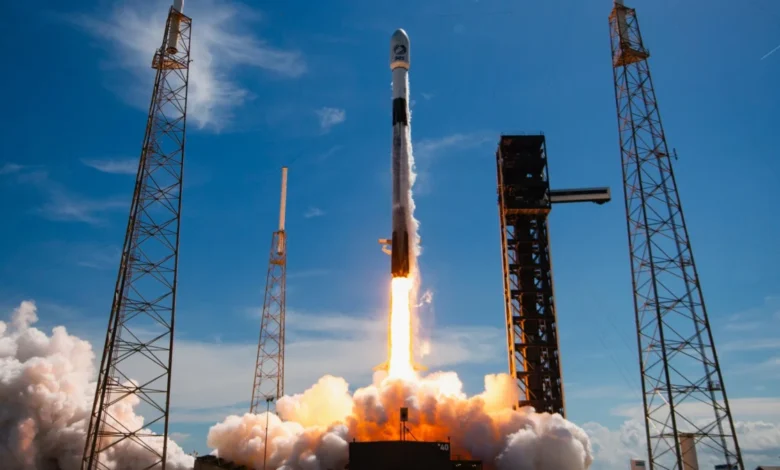
SpaceX achieved a major milestone in modern aerospace history on September 13, successfully launching a Falcon 9 rocket from Florida’s Cape Canaveral Space Force Station to deploy the final three telecommunications satellites for Luxembourg-based SES’s O3b mPOWER constellation. Liftoff occurred precisely at 2:49 p.m. EDT (1849 GMT), propelling the payload toward medium Earth orbit (MEO) and marking the 700th successful flight for the overarching Falcon rocket family.
This latest mission underscores the staggering launch cadence and reliability that SpaceX has cultivated over nearly two decades of commercial space operations. What began as an experimental lightweight rocket program has matured into the most prolific launch vehicle family in active service, fundamentally reshaping the economics of access to space.
A Historic Milestone: 700 Flights of the Falcon Family
The 700-mission milestone represents a dramatic trajectory for SpaceX, a company that faced near-bankruptcy following early consecutive failures of its initial launch vehicle. The legacy of the Falcon family traces back to March 2006 with the debut of the Falcon 1. Operating as a small-sat launch vehicle, the Falcon 1 flew five times, achieving two historic successes—including the first privately developed liquid-fueled rocket to reach orbit in September 2008—before being retired to clear a path for heavier architectures.
In 2010, the Falcon 9 made its maiden flight, immediately establishing a new standard for medium-to-heavy lift capability and reusability. Over the subsequent decade and a half, the Falcon 9 evolved through multiple iterative block upgrades to become the undisputed workhorse of the global launch market, handling everything from NASA cargo and crew resupply missions to commercial constellations and classified national security payloads.
Complementing the Falcon 9 is its heavy-lift derivative, the Falcon Heavy, which debuted in February 2018. Combining three modified Falcon 9 first-stage boosters, the Falcon Heavy has successfully flown 13 times to date, lofting massive deep-space probes, heavy military satellites, and specialized national security payloads. Together, the Falcon 9 and Falcon Heavy have forged an operational reliability record that has captured the lion’s share of the global commercial and institutional launch market.
Mission Profile and Booster Recovery
The September 13 mission was executed with signature precision. Approximately eight and a half minutes after lifting off from Space Launch Complex 40 (SLC-40) at Cape Canaveral Space Force Station, the Falcon 9 first-stage booster completed a flawless return to Earth. The booster, designated B1080 in SpaceX’s active fleet, touched down safely on the company’s autonomous droneship, "A Shortfall of Gravitas," stationed in the Atlantic Ocean.
This particular flight marked the 29th orbital journey for booster B1080, highlighting the profound economic and operational advantages of rapid rocket stage reusability. Once recovered, the booster will be transported back to port, refurbished, and prepared for yet another flight—a practice that has allowed SpaceX to compress turnaround times and drastically lower the marginal cost per kilogram to orbit.
Meanwhile, the Falcon 9’s single-engine Merlin vacuum upper stage continued its ascent, pushing the three O3b mPOWER satellites toward their targeted medium Earth orbit. Deployment occurred over a synchronized 14-minute window starting roughly 33.5 minutes after liftoff, releasing the spacecraft smoothly at an altitude of approximately 5,000 miles (8,000 kilometers).
Completing the O3b mPOWER Constellation
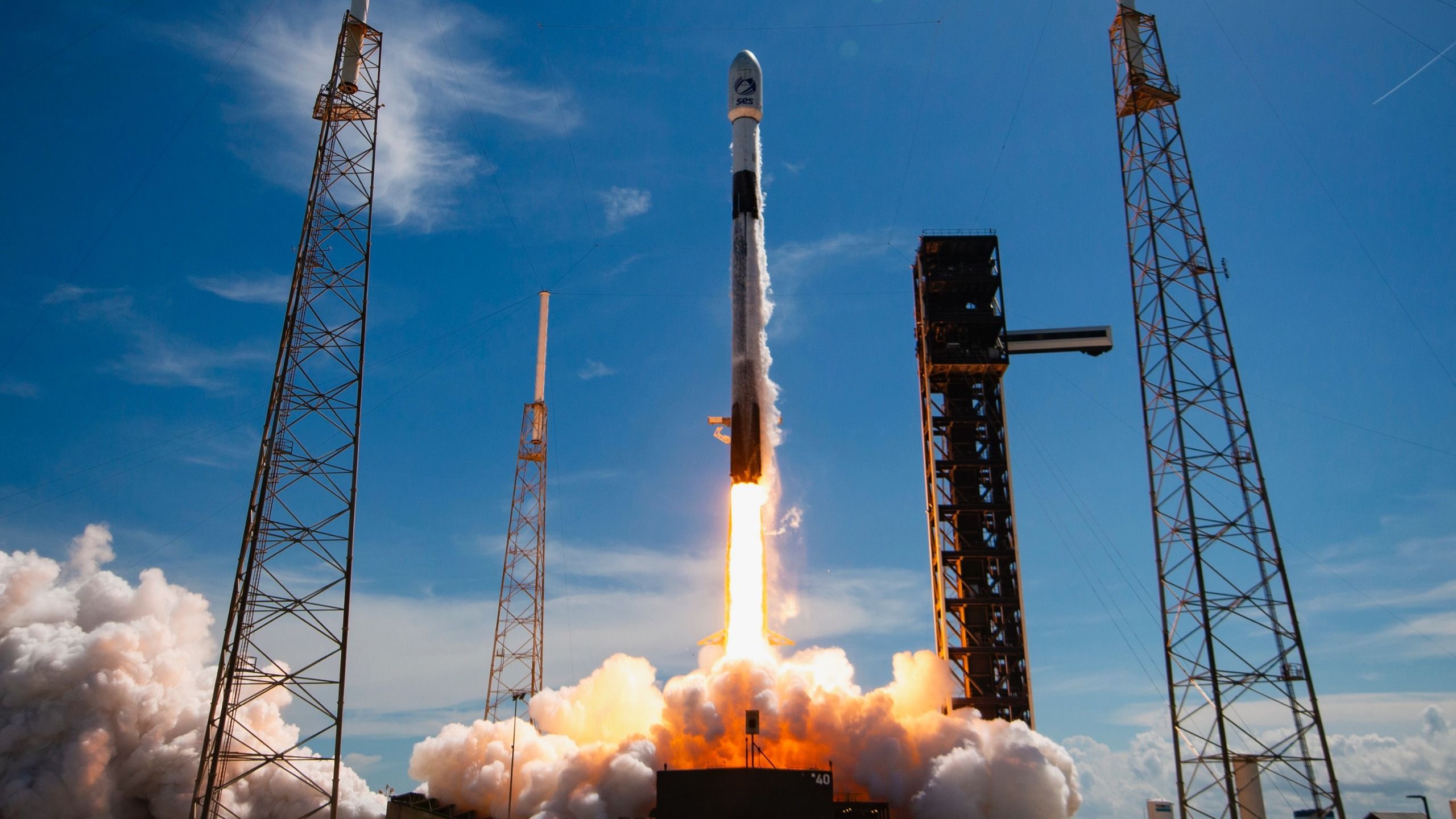
With the successful deployment of these final three spacecraft, SES has fully assembled its next-generation O3b mPOWER medium Earth orbit communications network. SES, one of the world’s leading content connectivity providers headquartered in Betzdorf, Luxembourg, already operated 10 O3b mPOWER satellites in MEO prior to this flight.
Built by aerospace prime contractor Boeing, each O3b mPOWER satellite weighs approximately 3,750 pounds (1,700 kilograms). SpaceX has maintained an exclusive launch partnership for the constellation, deploying all units across six dedicated Falcon 9 missions beginning in December 2022.
The O3b mPOWER system is engineered from the ground up to address the exponentially growing demand for high-throughput, low-latency connectivity. Unlike traditional geostationary (GEO) satellites, which operate at much higher altitudes and introduce noticeable communication delays, MEO constellations bridge the gap by offering fiber-like performance with the global reach of satellite communications.
According to technical briefs provided by SES, the constellation is purpose-built to deliver predictable low latency, exceptional data throughput, and unprecedented operational flexibility. The system pairs advanced, software-defined space hardware with an intelligent ground infrastructure, ensuring guaranteed performance levels for enterprise, government, maritime, aviation, and telecommunication carrier markets where mission-critical uptime is non-negotiable.
Broader Operational Context for SpaceX in 2026
The milestone flight is part of an extraordinarily busy manifest for SpaceX in 2026. The September 13 mission represented the company’s 107th orbital flight of the calendar year alone. Of those launches, the Falcon 9 has accounted for 105 flights, while the Falcon Heavy has executed the remaining two.
In parallel with its high-tempo Falcon operations, SpaceX has continued intensive developmental flight testing of its next-generation Starship megarocket from its Starbase facility in Boca Chica, Texas. Having successfully completed two suborbital test flights earlier in the year, engineers are currently preparing for the vehicle’s third major integrated flight test, which is widely anticipated to mark Starship’s maiden orbital flight.
Implications for Global Telecommunications and Space Commerce
The completion of the O3b mPOWER constellation carries profound implications for the global telecommunications landscape. As industries increasingly digitize, remote operations, cloud-based enterprise applications, cruise liners, commercial airlines, and defense agencies require massive, uninterrupted bandwidth pipelines regardless of geographical location.
Traditional terrestrial networks are often economically or physically infeasible in maritime environments, remote mining operations, and underserved geographic regions. Advanced MEO systems like O3b mPOWER, working alongside low Earth orbit (LEO) constellations, provide a robust multi-orbit resilience strategy for enterprise networks.
Furthermore, the smooth deployment underscores the maturity of the commercial launch sector. The reliability demonstrated by SpaceX’s 700 Falcon flights has transformed the aerospace industry, proving that high-cadence, reusable launch vehicles can be operated safely and profitably on a commercial scale. As SES integrates these final satellites into its operational network, global enterprise customers can expect a dramatic expansion in service availability, bandwidth capacity, and connection reliability, signaling a new chapter in global satellite-based connectivity.
Related posts: