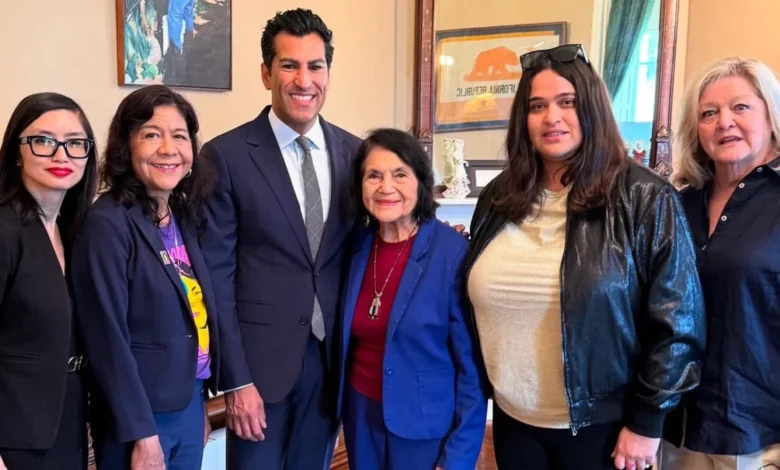
The passing of Dolores Huerta at age 96 marks the conclusion of a singular chapter in American history, closing the life of a woman who transformed the landscape of labor rights, feminist advocacy, and grassroots political organizing. A co-founder of the United Farm Workers (UFW) alongside Cesar Chavez, Huerta’s career spanned over seven decades, evolving from a local activist in California’s Central Valley to an international symbol of intersectional resistance. Her death, announced this week, has triggered an outpouring of tributes from political leaders, labor unions, and the millions of workers whose lives were altered by her tireless advocacy.
A Life Dedicated to Systemic Change
Born in 1930 in Dawson, New Mexico, and raised in Stockton, California, Huerta’s formative experiences as a teacher and community organizer provided the foundation for her later activism. Recognizing that many of her students were children of underpaid, unprotected farmworkers who lacked basic necessities, she left the classroom to pursue full-time labor organizing.
In 1962, she co-founded the National Farm Workers Association, which later merged with the Agricultural Workers Organizing Committee to become the United Farm Workers (UFW). Throughout the 1960s and 1970s, Huerta played a decisive role in the Delano Grape Strike, a pivotal movement that pressured agricultural giants to grant workers living wages, health benefits, and safer working conditions. Her ability to navigate both the fields and the halls of power made her a unique force; she was a brilliant negotiator who secured the first collective bargaining agreements for farmworkers in the United States.
Chronology of an Icon
Huerta’s trajectory was defined by a series of landmark victories that reshaped the American labor movement:
- 1955: Begins her organizing career with the Stockton Community Service Organization (CSO).
- 1962: Co-founds the National Farm Workers Association with Cesar Chavez.
- 1965: Serves as a lead negotiator in the Delano Grape Strike, a five-year battle that culminated in historic victories for the UFW.
- 1972: Coined the iconic slogan "Sí, se puede," which has since become a global rallying cry for social justice movements.
- 1988: Suffers life-threatening injuries during a peaceful protest in San Francisco, an event that galvanized public support for her causes and expanded her profile as a civil rights martyr.
- 2003: Establishes the Dolores Huerta Foundation to train the next generation of community organizers.
- 2012: Receives the Presidential Medal of Freedom from President Barack Obama, the highest civilian honor in the United States.
The Evolution of Intersectional Activism
While the UFW established her as a labor leader, Huerta’s influence expanded significantly in her later decades. She became a vocal proponent of intersectional politics, explicitly linking the struggles of farmworkers to the broader fights for LGBTQ+ rights, reproductive justice, and immigrant protections. Her willingness to support candidates and causes well into her 90s made her a fixture on the campaign trail, where she served as both a mentor to young progressives and a bridge to the era of mid-century civil rights organizing.
Her philosophy was rooted in the concept of "organizing every moment." Unlike many icons who retreat from the public eye in their final years, Huerta remained a constant presence. Whether lobbying in the California State Capitol or appearing at national political rallies, she maintained a grueling schedule that challenged conventional expectations of aging. Colleagues and political allies often noted that her energy surpassed that of organizers decades her junior.
The Data Behind the Movement
The impact of Huerta’s work is quantifiable through the legislative and social shifts she helped catalyze. Under her guidance, the UFW secured the California Agricultural Labor Relations Act of 1975, the first law in the nation to recognize the right of farmworkers to organize and bargain collectively. This legislation served as a blueprint for agricultural labor protections across several states.
Furthermore, her foundation, the Dolores Huerta Foundation, has focused on "civic engagement and leadership development," reporting that it has trained thousands of low-income residents in the Central Valley to engage in school board meetings, city council sessions, and voter registration drives. Her focus on shifting the power dynamic from the top-down to the bottom-up created a sustainable infrastructure for activism that continues to operate today.
Official Responses and Public Tributes
Following the announcement of her passing, reactions poured in from across the political spectrum. California Assembly Speaker Robert Rivas, who frequently collaborated with Huerta on labor legislation, described her as "the moral compass of our state." In a statement, the White House acknowledged her as a "giant of the American labor movement," noting that her work "did not just change the law; it changed the culture of our nation."
Labor unions, including the AFL-CIO and the Teamsters, issued statements highlighting her role in making labor movements more inclusive of women and minority workers. "Dolores showed us that power is not something given to you by the elite," said a spokesperson for the AFL-CIO. "It is something you build, person by person, in the fields and in the streets."
A Lasting Cultural and Political Legacy
Huerta’s influence extends beyond policy and into the cultural lexicon of the United States. The phrase "Sí, se puede" transcended its origins in the fields of Delano to become a staple of political discourse. By framing the struggle for labor rights as a matter of universal human dignity, she provided a vocabulary for generations of activists to articulate their own demands for justice.
Her insistence on "organizing as a way of life" served as a counter-narrative to the episodic nature of modern social media activism. By emphasizing that every person is a potential activist and every minute an opportunity for change, she demystified the process of social transformation. She did not position herself as a messianic figure; rather, she often rejected comparisons to other historical saints, preferring to align herself with radical labor agitators like Mother Jones.
Implications for the Future of Labor
The passing of Dolores Huerta comes at a complex time for the American labor movement. As the gig economy expands and the traditional workforce faces new challenges from automation and globalization, the strategies pioneered by Huerta—such as deep, community-based organizing and the cultivation of local leadership—are being revisited by contemporary labor organizers.
The challenge for the organizations she left behind, including the Dolores Huerta Foundation and the UFW, will be to maintain the momentum of her work without the direct, day-to-day guidance of its most recognizable face. However, analysts suggest that her long-term strategy of training others to take up the mantle has provided a robust succession plan. The thousands of organizers who passed through her training programs now occupy positions in government, education, and labor, ensuring that her methodology persists.
Ultimately, Huerta’s life provides a case study in the efficacy of persistent, principled advocacy. She operated on the belief that institutional change is only possible when individual citizens are empowered to act in their own communities. As the nation mourns her, the focus of her admirers is shifting toward the preservation of her archives, the continuation of her foundation’s work, and the integration of her lessons into the next phase of the labor rights struggle. Her death is not the end of the movement she helped build, but a call for its continued evolution. The slogan she gave to the world remains the guiding principle for those she leaves behind: Sí, se puede.