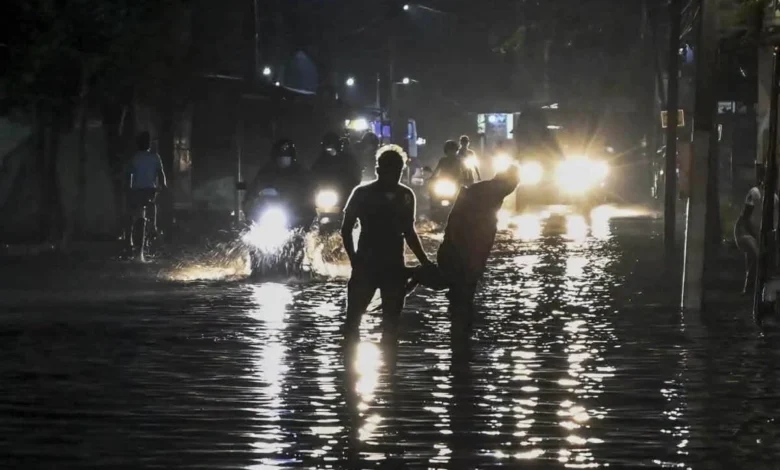
On November 6, the commercial capital of Sri Lanka, Colombo, was brought to a standstill as an intense, short-duration deluge dumped 129 millimeters (5 inches) of rain on the city in a matter of minutes. The flash flood, which caught residents and commuters off guard, transformed busy thoroughfares into rivers, submerged parked vehicles, and highlighted the catastrophic failure of the city’s aging infrastructure to cope with modern climate volatility.
The chaos of the day was encapsulated by the experience of local commuters, such as Siva Sivasagunthan, a ride-hailing driver. Sivasagunthan reported that his vehicle was quickly partially submerged as water levels rose with startling speed. A journey that typically requires 30 minutes in standard traffic conditions extended to over two hours, as gridlock and flooded intersections paralyzed the metropolitan area. The event has reignited urgent debates regarding the city’s capacity to handle extreme weather, the maintenance of its drainage systems, and the long-term environmental consequences of unchecked urban development.
A History of Intensifying Weather Patterns
While flooding is a recurring challenge for Colombo—a city situated in a low-lying coastal basin—the intensity of recent rainfall events has raised alarms within the meteorological community. According to Ajith Wijemanna, director of Sri Lanka’s Department of Meteorology, the sheer velocity of the precipitation is a growing concern.

Historical data reveals that while Colombo has weathered extreme rainfall before, the current frequency and intensity are pushing the city’s resilience to its breaking point. In June 1992, the city recorded a staggering 493.7 mm (19.4 inches) of rain within a 24-hour period. Similarly, in November 2010, 440.2 mm (17.3 inches) fell in a single day. However, Wijemanna notes that comparing total daily rainfall is less relevant today than analyzing the "rainfall intensity"—the speed at which water accumulates per hour.
On November 6, meteorological sensors recorded intensity levels exceeding 120 mm (4.7 inches) per hour in some parts of the city, with other gauges indicating a peak of 135 mm (5.3 inches) per hour. "We believe the main cause of the flooding was the high intensity during a short period of time, which was similar to a gushing downpour," Wijemanna explained. The department currently operates without advanced Doppler radar systems, which are critical for providing the early warnings necessary to mitigate such disasters. Without this technology, the lead time for public alerts remains dangerously short.
The Failure of Century-Old Infrastructure
The immediate response to the crisis was a frantic effort by municipal authorities to address chronic blockages in the city’s drainage network. Prime Minister Harini Amarasuriya had previously issued directives to local authorities to clear canals and waterways, but the November 6 event revealed the limitations of these efforts. Post-flood assessments identified at least 60 key locations where debris, sediment, and structural neglect had completely obstructed the flow of water.
Deepika Wijethilake, deputy director of drainage design at the Colombo Municipal Council (CMC), pointed to a structural mismatch between the city’s design and the modern climate reality. The existing sewer and storm water systems are approximately 100 years old and were engineered as separate entities to handle a significantly smaller urban footprint.

"The storm water system was designed to accommodate a capacity of 30 mm (1.18 inches) of rainfall per hour," Wijethilake stated. "When you receive more than 100 mm per hour, the system is fundamentally overwhelmed." The problem is compounded by the rapid expansion of concrete pavements and high-density residential buildings, which have drastically reduced the city’s permeability. With less ground available to absorb rainfall, surface runoff has increased, placing even greater pressure on a system that was never designed for the current urban density.
Real Estate Development and the Loss of Natural Buffers
The crisis is not solely one of concrete pipes and drain maintenance; it is an ecological failure. Colombo is a RAMSAR-accredited wetland city, and its natural landscape was historically designed to act as a sponge for the Kelani River basin. However, the encroachment of real estate development into these protected areas has stripped the city of its natural defenses.
A 2025 study by the Centre for a Smart Future (CSF) titled Shifting Grounds details how developers are exploiting the "green" appeal of wetlands to market exclusive residential enclaves. Projects in areas like Kaduwela, Malabe, and Thalawathugoda are often built on or near critical wetland complexes, marketed as serene, nature-friendly living spaces. Yet, as the study highlights, these developments often ignore the ecological functions of these landscapes.
"These property developers are leveraging the wetland to create demand and price premiums, but they are doing little to ensure their projects are nature-positive," says Anushka Wijesinha, co-founder and director of the CSF. Property values in these wetland-adjacent zones have seen annual spikes of 30-40%, yet this economic growth is decoupled from the environmental risks. By filling in wetlands for construction, developers are removing the very infrastructure that prevents flooding, creating a "resilience paradox" where the value of a property is threatened by the environmental destruction required to build it.

The Economic Imperative for Resilience
The economic stakes for Colombo are immense. As the capital and a major logistics hub, the city contributes over 45% of Sri Lanka’s total GDP. Flooding is not just an inconvenience for commuters; it is a systemic risk to the nation’s supply chain and economic competitiveness.
Environmental scientist Chethika Gunasiri notes that wetlands provide essential ecosystem services that would cost billions of dollars to replicate through human-made engineering. "The Colombo Wetland Complex retains 37% of the rainwater that enters the city," Gunasiri explained. "When we allow these areas to be invaded by invasive species like the pond apple (Annona glabra) or paved over for construction, we lose that retention capacity."
To address this, experts are calling for a fundamental shift in how Colombo manages its landscape. Gunasiri points to the Copenhagen model, which incorporates "cloudburst" management—converting roundabouts into rain gardens, building small retention ponds, and installing bioswales along roads to naturally filter and absorb water before it reaches the municipal drainage system.
A Path Toward Adaptation
The path forward requires both immediate tactical repairs and long-term structural financing. The CMC has announced plans to redesign drainage systems to withstand a threshold of 100 mm of rain per hour, though such a project will be costly and time-consuming.

Anushka Wijesinha advocates for the creation of an "adaptation and resilience fund." This proposed mechanism would blend government resources with bilateral grants, multilateral development bank financing, and a levy on property developers who benefit from wetland-adjacent projects. "The biggest risk we face now is fiscal," Wijesinha argued. "We need a dedicated financial reserve that allows local authorities to invest in climate-resilient infrastructure before the next storm, rather than scrambling to fund disaster relief afterward."
As of late November 2026, the cleanup of canals and the removal of silt continue in high-risk zones. The November 6 flooding serves as a stark reminder that as Colombo grows, its reliance on both "grey" infrastructure—drains and pipes—and "green" infrastructure—wetlands and natural floodplains—must be managed in tandem. If the city continues to prioritize aesthetic real estate development over the preservation of its natural hydrology, the cost of future floods will likely far exceed the value of the developments that currently occupy the city’s flood-prone lands.
For the residents of Colombo, the sight of dark clouds, once a sign of a refreshing break from the tropical heat, has become a signal of anxiety. As urban sprawl continues to outpace environmental planning, the city’s survival as a resilient economic hub will depend on its ability to integrate its ancient geography with a modernized, climate-conscious urban strategy. Whether through the restoration of degraded wetlands or the implementation of sophisticated, nature-based drainage solutions, the message from the recent floods is clear: the era of reactive disaster management must give way to proactive, resilient urban design.