Faraday Future Intelligent Electric Inc. (FFIE), the California-based electric vehicle startup that once aimed to dethrone Tesla with its ultra-luxury FF 91, has announced a drastic 1-for-150 reverse stock split in a desperate bid to maintain its listing on the Nasdaq Stock Market. The move, scheduled to take effect on July 24, 2024, underscores the ongoing existential crisis facing the company as it pivots its business model from high-end automotive manufacturing to a broader "Embodied AI" ecosystem, including the production and sale of robots.
The reverse stock split is designed to artificially inflate the company’s share price, which has been languishing in "penny stock" territory for months. As of late July, Faraday Future’s stock was trading at approximately eight cents per share, representing a staggering 92% decline year-to-date. This valuation is only marginally above its 52-week low of $0.066, a far cry from the optimistic highs seen during its initial public offering via a Special Purpose Acquisition Company (SPAC) merger in 2021. By consolidating every 150 existing shares into one "new" share, the company expects the trading price to jump to approximately $12 per share, comfortably exceeding the Nasdaq’s $1.00 minimum bid price requirement for continued listing.
The Mechanics of the Reverse Split and Nasdaq Compliance
The decision to execute a reverse split was not made lightly but was necessitated by a series of deficiency notices from Nasdaq. Under Nasdaq Listing Rule 5450(a)(1), a company must maintain a minimum bid price of $1.00 per share. If a stock remains below this threshold for 30 consecutive business days, it risks being delisted. Delisting is often a death knell for struggling startups, as it severely limits access to institutional capital and reduces liquidity, moving the stock to over-the-counter (OTC) markets where oversight is less rigorous and investor confidence is lower.

The 1-for-150 ratio is particularly aggressive, reflecting the depth of the company’s share price erosion. Upon the split’s effective date, the total number of outstanding common shares will be reduced from approximately 384,527,828 to roughly 2,563,519. While the total market capitalization remains unchanged by the split itself, the company hopes the higher per-share price will attract institutional investors and professional funds that are often prohibited by internal mandates from investing in stocks priced under $5.00.
In an official statement, Faraday Future characterized the split as a "sustainable compliance buffer." Management argued that the move would "enhance the attractiveness of the company’s common stock to a broader range of investors" and provide the stability needed to execute its long-term strategic pivot. However, market analysts remain skeptical, noting that reverse splits are often viewed as a temporary "band-aid" that does not address the underlying operational failures or the high "burn rate" of cash that continues to plague the organization.
A Turbulent History: From Tesla-Killer to Survival Mode
To understand Faraday Future’s current predicament, one must look back at its tumultuous decade-long history. Founded in 2014 by Chinese billionaire Jia Yueting, the company arrived on the scene with massive ambition. It recruited top-tier talent from Tesla, BMW, and Apple, promising to revolutionize the automotive industry with a vehicle that was part limousine, part supercar, and part mobile living room.
The company’s flagship model, the FF 91, debuted at the Consumer Electronics Show (CES) in 2017 to significant fanfare. Boasting 1,050 horsepower, a 0-60 mph time of under 2.4 seconds, and a luxury interior featuring "zero-gravity" seats, the FF 91 was positioned as a pinnacle of EV technology. However, the years that followed were marred by financial instability, legal battles involving Jia Yueting’s personal debts in China, and repeated delays in production.

By the time the company finally managed to deliver its first "FF 91 2.0 Futurist Alliance" to a customer in 2023—priced at a whopping $309,000—the EV market had shifted significantly. Competitors like Lucid Motors and Rivian had already entered the luxury space, and the global automotive industry was beginning to grapple with a slowdown in EV demand. Faraday Future’s inability to scale production at its Hanford, California, facility meant that its delivery numbers remained in the single digits for a prolonged period, leading to a massive drain on resources without a corresponding revenue stream.
The Strategic Pivot: Robots and the China-U.S. Automotive Bridge
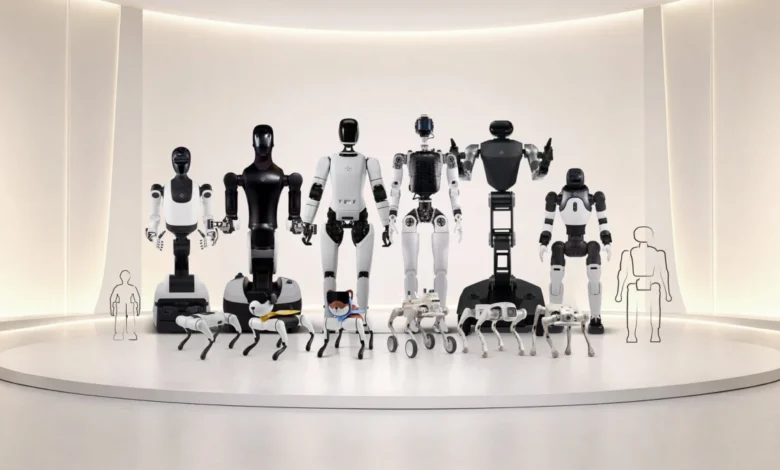
Recognizing that the ultra-luxury EV market may no longer be a viable path to solvency, Faraday Future has recently embarked on a series of radical strategic shifts. The most notable is its transition into what it calls a "global Embodied AI ecosystem company." This pivot involves leveraging the software and AI capabilities developed for the FF 91 to create autonomous robotic systems.
According to recent corporate filings, the company has surpassed 250 cumulative units in sales, shipments, and deliveries of its robot products. While details on the specific nature and application of these robots remain sparse, the company appears to be targeting industrial or service-oriented sectors where AI integration is in high demand.
Furthermore, Faraday Future has introduced the "China-U.S. Automotive Bridge Strategy." This initiative aims to position the company as a facilitator for Chinese automotive manufacturers and parts suppliers looking to enter the North American market. By offering its regulatory expertise, California-based manufacturing footprint, and AI technology, Faraday Future hopes to generate revenue as a consultant and partner rather than just a standalone vehicle manufacturer.

As part of this broader AI strategy, the company recently announced the "FX" (Faraday X) brand. This sub-brand is intended to focus on more "affordable" AI-driven vehicles, moving away from the $300,000 price point of the FF 91. In May 2024, however, the company reportedly paused development on certain FX models to conserve cash, highlighting the constant tension between its ambitious roadmap and its depleted treasury.
Recent Technological Developments: The AIHER System
Despite its financial woes, Faraday Future continues to iterate on its intellectual property. In June 2024, the company announced it had received a patent for a new hybrid transmission system. This technology is expected to be a cornerstone of the "AIHER" (AI Hybrid Extended-Range) system currently under development.
The move toward extended-range electric vehicles (EREVs) is a significant departure from the company’s original pure-BEV (Battery Electric Vehicle) mission. EREVs use a small internal combustion engine solely as a generator to charge the battery while driving, eliminating range anxiety—a major hurdle for EV adoption. This shift aligns Faraday Future with a growing trend in the Chinese market, where EREVs have seen surging popularity due to their practicality in regions with underdeveloped charging infrastructure.
Financial Standing and Market Sentiment
The financial data paints a grim picture for the EV startup. In its most recent filings, Faraday Future has consistently issued "going concern" warnings, stating that it does not have sufficient liquidity to fund operations for the next twelve months without additional financing. The company has survived thus far through a combination of convertible note issuances, equity offerings, and support from a small group of loyal investors.

Investor sentiment remains largely bearish. Critics argue that the company’s pivot to robots and the "Automotive Bridge" strategy are distractions from its failure to mass-produce a viable car. The 92% drop in stock price this year reflects a loss of confidence in management’s ability to execute. While the reverse stock split will provide a temporary reprieve from Nasdaq delisting, the fundamental question remains: can Faraday Future generate enough revenue to stop the bleeding?
Timeline of Recent Events
- January 2024: FFIE stock falls below $0.10 as deliveries of the FF 91 remain stagnant.
- February 2024: The company announces a formal shift toward "Embodied AI" and robotics.
- May 2024: Development of the FX minivan and certain affordable EV models is "paused" to prioritize cash preservation.
- June 2024: Faraday Future receives a patent for its AI Hybrid Extended-Range (AIHER) transmission system.
- July 2024: The board approves a 1-for-150 reverse stock split to maintain Nasdaq compliance.
Broader Implications for the EV Startup Landscape
Faraday Future’s struggle is emblematic of the "EV Winter" facing many startups that went public during the SPAC boom of 2020-2021. Companies like Fisker Inc. have already filed for bankruptcy, while others like Lordstown Motors have liquidated. The high capital intensity of automotive manufacturing, combined with rising interest rates and a cooling of consumer enthusiasm for high-priced EVs, has created a "survival of the fittest" environment.
Faraday Future’s attempt to reinvent itself as an AI and robotics firm is a unique gamble. If it can successfully monetize its 250+ robot units and leverage its "Bridge Strategy" to help Chinese OEMs navigate U.S. tariffs and regulations, it may find a niche that allows it to survive. However, if the reverse split is followed by further share price erosion—a common occurrence for companies in financial distress—the window of opportunity will likely close for good.
As the July 24 deadline approaches, the market will be watching closely to see if the "new" $12 share price can hold or if Faraday Future will continue its downward trajectory. For now, the company remains "alive somehow," as it continues to navigate one of the most challenging periods in its decade-long history of survival against the odds.